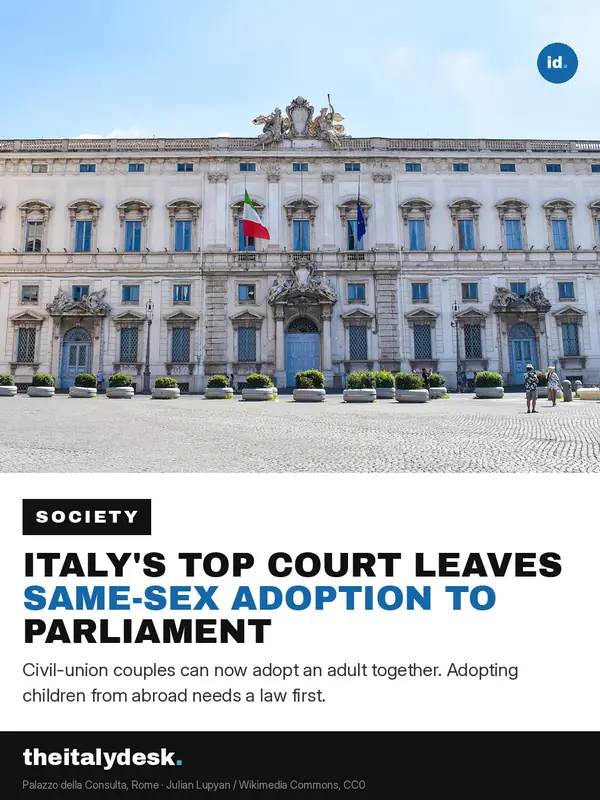
Italy's top court leaves same-sex adoption to Parliament
Italy's Constitutional Court published two rulings on 12 November that answer two different questions about same-sex couples and adoption. Partners in a civil union can now adopt an adult together, as married couples already could. Whether they can adopt an abandoned child from abroad, the Court said, is for Parliament to decide. This piece explains what each ruling says, the two cases behind them, where Italian adoption law stands after them, and what the different sides have said.
Two rulings, two answers
| Ruling 195/2026 | Ruling 194/2026 | |
|---|---|---|
| Question | Can two people in a civil union jointly adopt an adult? | Can a civil-union couple apply to adopt a child from abroad? |
| Raised by | Ordinary court of Milan, order of 18 November 2025 | Juvenile court of Venice, order of 12 March 2026 |
| Rule examined | Civil Code, article 294, second paragraph | Law 184 of 1983, article 29-bis, first paragraph |
| Outcome | Rule struck down where it excludes civil unions | Question declared inadmissible: the rule stays |
| What changes | Joint adult adoption opens to civil-union couples | Nothing for now; the Court asks Parliament to decide |
The Constitutional Court (Corte costituzionale, often called the Consulta after the palace where it sits in Rome) reviews whether laws comply with the Constitution. It does not hear cases directly: an ordinary court that doubts a law sends the question to it, and its answer applies to everyone.
The adult adoption case
The Milan case involved two people who had been together for more than thirty years and entered a civil union in 2016. They asked to adopt a woman, the niece of one of them, whom both had known since her birth. She and her biological mother agreed, according to Open.
Article 294 of the Civil Code allows two people to adopt the same adult only if they are married. The Court found that rule "unreasonable and disproportionate" in so far as it excludes civil-union partners, citing articles 2 and 3 of the Constitution (inviolable rights and equality) and the right to private and family life under the European Convention on Human Rights. In its reasoning, the adoption of an adult gives legal recognition to an emotional bond that, "for quality, intensity and reasonable duration", already shapes the identity of the people involved, as ANSA reported.
The Court left untouched a clause of the 2016 civil unions law (law 76/2016, article 1, paragraph 20) that keeps ordinary courts from extending adoption rules written for spouses to civil unions. According to money.it, the Court said that clause binds judges but not the Court itself.
Adult adoption in Italy is mostly about inheritance and family name. The adopter must be at least 35 and at least 18 years older than the person adopted, though courts can make exceptions. The adopted adult adds the adopter's surname, gains inheritance rights and keeps all ties with their birth family. The change takes effect from the day after the ruling appears in the Gazzetta Ufficiale, the official journal. The rulings we read do not say how surnames combine when there are two adopters.
The international adoption case
The Venice case involved a couple who had lived together since 2017 and entered a civil union in 2019. They asked to be assessed for the international adoption of a child. The checks were positive, Open reports: no criminal record and a favourable opinion from social and health services. The juvenile court in Venice then asked whether the law that reserves international adoption to married couples could have "unreasonable, discriminatory and unjustified effects".
The Court declared the question inadmissible. Deciding which families can take in an abandoned child from abroad, it said, requires a balance of interests that belongs first to the legislature. The difference from the Milan case, in the Court's reasoning, is that here the law is not recognising a relationship that already exists but placing a child who has none.
The ruling still went further than a plain refusal. According to ANSA and Open, the Court:
- said "it will be for the legislator to carry out the assessment of the best interest of the child", and that the core of adoption law must remain "the child's right to a family";
- said Parliament may consider "the availability of same-sex couples in civil unions" to be assessed for adoption out of a "spirit of solidarity", which it linked to article 2 of the Constitution;
- noted that Italian family law has "profoundly changed", citing civil unions, the reform of divorce and court decisions recognising parent-child ties in same-sex couples;
- said a couple's sexual orientation has no bearing on fitness to be parents, and that there is no scientific evidence of harm to children raised by same-sex couples.
Until Parliament acts, civil-union couples cannot jointly apply for international adoption.
Where adoption law stands now
Italy has had civil unions for same-sex couples since 2016, under the law known by the name of its sponsor, Senator Monica Cirinnà. Marriage is reserved to a man and a woman. During the final vote in 2016, an article that would have let a partner adopt the other partner's child was dropped. Since a Court of Cassation ruling that same year, courts have often allowed it anyway, through the "adoption in special cases" in article 44 of law 184/1983, decided one case at a time.
| Who | Adopt a child in Italy | Adopt a child from abroad | Adopt an adult jointly |
|---|---|---|---|
| Married couple | Yes | Yes | Yes |
| Single person | Only in special cases | Yes, since ruling 33/2025 | Not applicable |
| Civil-union couple | Partner's child, via special cases | No, Parliament to decide | Yes, since ruling 195/2026 |
The opening for single people came in March 2025. In ruling 33/2025, on a question from the juvenile court of Florence, the Court allowed single people to apply for international adoption. The courts still assess each applicant's fitness, and the child's country of origin decides whether a match exists.
Fewer families adopt from abroad each year. The Commission for International Adoptions, the government body that oversees the process, says international adoptions have fallen by about 90% in 13 years, as Il Post reported. Il Post points to high costs, long waits, countries such as China closing their programmes, and wider use of assisted reproduction.
What the different sides say
- Gabriele Piazzoni, general secretary of Arcigay, Italy's largest LGBT+ association, welcomed the rulings and said the Court's invitation "should be taken literally", asking Parliament to apply "common sense and not ideology" to parenthood (ANSA, La Sintesi).
- Alessandro Zan, an MEP who leads on rights for the Democratic Party (PD), the main opposition party, said the two rulings confirm that a law is needed and that same-sex couples should not be excluded from adoption because of their sex. He accused the Meloni government of only being able "to discriminate and make propaganda", and said a law would be a task for the next legislature (Open, La Sintesi).
- Pro Vita & Famiglia, a Catholic advocacy group, called the Venice referral "serious" when it was announced in March. Its spokesman Jacopo Coghe said adoption exists to give a child "a mother and a father", not to satisfy an adult "right to a child" (Panorama, 15 March 2026).
- The government's lawyers, the Avvocatura dello Stato, had asked the Court to reject the Venice question on preliminary grounds. The Court dismissed those objections before declaring the question inadmissible (money.it).
In the reports we read, we found no statement on the rulings from the government or from the parties of the governing coalition by the evening of 13 November.
What happens next
- Ruling 195 takes effect once it is published in the Gazzetta Ufficiale. The Milan court then decides the couple's request under the new rule.
- For children from abroad, nothing changes unless Parliament passes a law. We found no bill on this point scheduled for debate.
- The current legislature ends in 2027, when Italy is due to hold a general election.
Corte costituzionale, rulings 194 and 195 of 12 November 2026 and ruling 33 of 21 March 2025, as reported by ANSA (12 November 2026), Open (12 November 2026), money.it (13 November 2026), La Sintesi (12 November 2026), Sky TG24 (21 March 2025); Il Post, 24 August 2025; Il Sole 24 Ore, 23 March 2025; Panorama, 15 March 2026; law 76/2016; law 184/1983.
Found this useful? The Italy Desk is free to read. A small tip helps us keep it that way.
Support us on Ko-fi