Italy moves to ban social media for under-13s
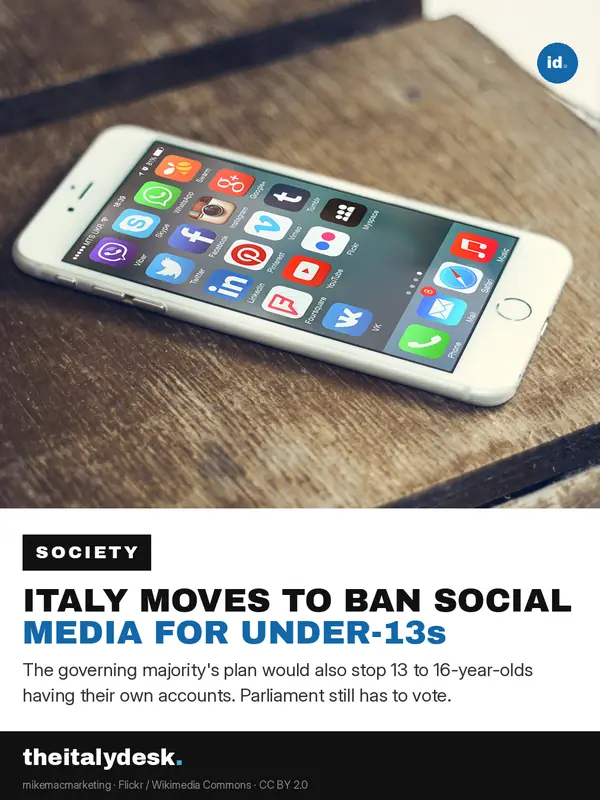
Italy's governing coalition wants to ban children under 13 from social media, and to do it within weeks. The plan is an amendment to a security decree that is already in force and that Parliament must confirm by late December. Under 13, no social media at all; between 13 and 16, only an account linked to a parent's; from 16, free access. The idea has support well beyond the government, but the method, the missing details on age checks and a freeze ordered by the European Commission all stand in the way. This piece explains what is proposed, where it comes from, what is still unknown and how it compares with what other countries have tried, as things stood on 18 November 2026.
What the amendment would do
The text had not been published on the evening of 18 November, the deadline for amendments. What is known comes from reports by ANSA, Repubblica and others, confirmed by parliamentary sources according to Byte.it.
| Age | What the plan allows |
|---|---|
| Under 13 | No registration on and no access to social networks |
| 13 to 15 | No account of their own; only an account linked to a parent's account |
| 16 and over | Free registration on any platform |
The first signatory is Fabio Rampelli of Brothers of Italy, the prime minister's party, who is a vice president of the Chamber of Deputies. According to ANSA, as reported by Byte.it, the prime minister's office contributed decisively to the drafting. Rampelli called it "a decisive turning point" for parents and accused the platforms of using algorithms that harm children's minds for commercial gain.
Three things are missing from every report we read: how platforms would have to check a user's age, what sanctions they would face if they broke the rule, and when the ban would start.
Why a security decree
The vehicle is decree-law 190 of 22 October 2026, a security decree that the government adopted after violent street clashes in Milan in October. In Italy a decree-law takes effect at once but lapses unless Parliament converts it into law within 60 days, so this one has to pass both chambers by 21 December (Agenda Digitale). The majority's stated target is the end of November.
Putting the ban there is a shortcut. Lavinia Mennuni, a Brothers of Italy senator, said the decree "allows us to have a rule within 60 days". The ordinary bill on the same subject has been stuck for a long time:
- Bill 1136, first signed by Mennuni, was presented in the Senate on 13 May 2024 and has cross-party backing, including from Marianna Madia, now with the centrist Italia Viva.
- In committee the rapporteur's base text set the age for opening an account at 15, and that is the version Italy notified to the European Commission.
- Other bills on the same subject, including ones by Carlo Calenda of Azione and Barbara Floridia of the Five Star Movement, sit in the same Senate committee (Key4biz).
According to Key4biz, Prime Minister Giorgia Meloni had earlier said the issue was for Parliament to decide, and changed course after the October clashes. An April 2026 draft from her office, with a threshold of 15 and fines for parents, was shelved in May (Agenda Digitale).
Who supports it and who objects
The aim has wide support; the method does not.
- Education Minister Giuseppe Valditara welcomed the plan and called a ban under 13 one of his long-standing battles.
- The psychologists' association AUPI backed the age limit and asked for a permanent national observatory on the effects of digital technology on children's mental health (Byte.it).
- Noi Moderati, a smaller coalition party, said it would table its own amendment, with private-by-default accounts and no profiling for 13 to 16-year-olds.
- Marianna Madia (Italia Viva) said the measure is right but called it only "better than nothing", criticising the government for stalling the bill and then moving it into a security decree.
- Barbara Floridia, a Five Star Movement senator, regretted the years lost and repeated her party's opposition to the decree that would carry the rule.
There is also a procedural risk. Italy's Constitutional Court has ruled (judgments 22/2012 and 32/2014) that amendments to a decree must be consistent with its subject. Simona Malpezzi of the Democratic Party has noted that earlier, similar proposals were declared inadmissible, Agenda Digitale reports.
The European obstacle
Brussels is writing its own rules. On 17 September 2026 the European Commission proposed a regulation, the EU Kids Act, which would bar under-13s from most social media, allow supervised "mini accounts" at 13 and 14 and full accounts from 15, with fines of up to 6% of a platform's global turnover (Byte.it). It still needs the approval of the European Parliament and the member states.
At the end of October the Commission told member states to hold off. Its spokesperson, Thomas Regnier, said it had "decided to postpone for 12 months any draft national laws overlapping with the future harmonised rules" (The Next Web). The tool is the EU procedure under which governments must notify technical rules for online services before adopting them. Austria's planned ban for under-14s is frozen as a result.
Rampelli and Mennuni say Italy avoided the same fate because it notified the Senate bill in time. Agenda Digitale points out a possible problem: the notified text set a single threshold of 15, not the 13 and 16 now proposed, so the amendment may need a new notification.
What other countries have done
| Country | Measure | Status |
|---|---|---|
| Australia | No accounts under 16 | In force since 10 December 2025 |
| France | Ban under 15 | Struck down by the Constitutional Council on 14 August 2026 |
| Greece | Ban under 15 | Due from 1 January 2027 |
| Austria | Minimum age 14 on video platforms | Frozen by the Commission |
| Denmark | Threshold of 15 | Planned |
Australia is the test case everyone cites. Agenda Digitale reports about 4.7 million accounts removed or restricted, and an evaluation by the country's eSafety Commissioner in July 2026 finding that the share of under-16s with an account fell from 52.4% to 42.1% in three months: lower, but far from zero.
France shows the legal risk. Its Constitutional Council found the ban an unsuitable, unnecessary and disproportionate limit on freedom of expression, too broad in the services it covered, and said the law gave no safeguards for how ages would be checked (LCP). The French government says it will rewrite it.
How would ages be checked?
Today Italian law already sets 14 as the age at which children can consent alone to the use of their data online (article 2-quinquies of the privacy code). In practice that usually rests on a simple self-declaration.
For adult websites, AGCOM, the communications regulator, has required since 12 November 2025 a "double anonymity" system: a third party certifies the user's age without knowing which site they visit, and the site never learns who the user is. Experts quoted by Key4biz, such as Ivana Bartoletti, cite it as a possible model. The EU Kids Act favours a European age-verification app that stores no documents or biometric data. The amendment, as reported, picks neither.
What happens next
- The text of the amendment, and whether the Justice Committee of the Chamber admits it.
- The votes in both chambers before the decree expires on 21 December.
- Whether Italy notifies the new thresholds to Brussels, and how the Commission responds.
- The EU Kids Act negotiations; the public consultation closes on 26 November.
Nothing changes for families yet: Parliament still has to vote.
Agenda Digitale, 18 November 2026; Byte.it, 18 November 2026; Key4biz, 18 November 2026; Quotidiano Nazionale, 17 November 2026; Gente d'Italia, 18 November 2026; The Next Web, 1 November 2026; LCP, August 2026; ANSA and Repubblica via Byte.it and Key4biz.
Found this useful? The Italy Desk is free to read. A small tip helps us keep it that way.
Support us on Ko-fi