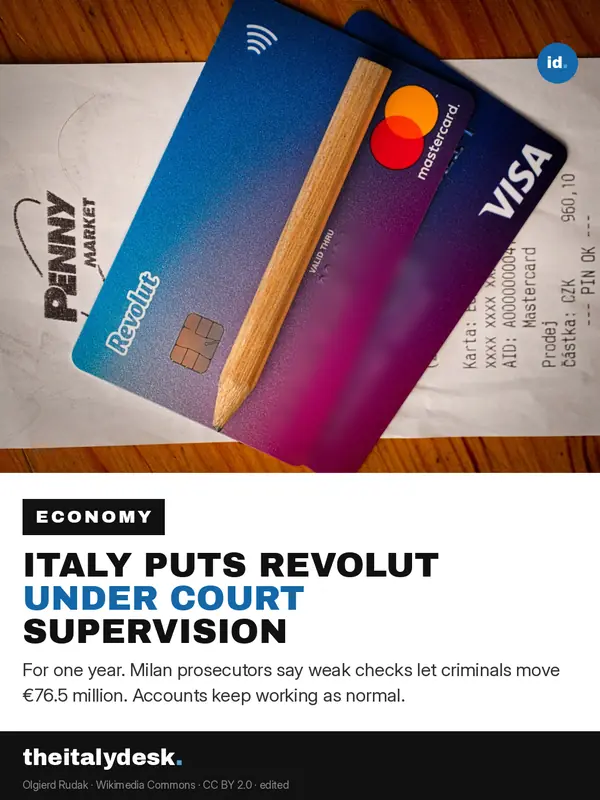
Why Italy put Revolut under court supervision
A Milan court has placed the Italian branch of Revolut, the London-based digital bank, under judicial administration for one year, after prosecutors argued that its anti-money laundering checks let people under investigation or already convicted move and hide money through its accounts. The bank is not under criminal investigation, accounts keep working, and Revolut says it will cooperate. This piece explains what the measure is, what the court and prosecutors found, how the numbers compare with other banks, and what it means for the bank's customers in Italy, with the facts as they stood on 17 November 2026.
What the court decided
The order comes from the prevention measures section of the Tribunal of Milan, at the request of the Milan prosecutor's office. AFP reports that the document is dated 12 November; it became public on Monday 16 November. It was carried out by the Guardia di Finanza, Italy's financial police.
The legal basis is article 34 of Italy's Anti-Mafia Code (Legislative Decree 159 of 2011), according to MF Milano Finanza. The article lets a court put a company under "amministrazione giudiziaria", judicial administration, when its business ends up helping people who are subject to anti-mafia measures or are being prosecuted for certain serious crimes, even if the company itself is not accused of anything. The measure lasts up to a year and can be extended.
It is not a sanction. Reuters, which reviewed the 39-page ruling, describes it as preventive rather than punitive. The company keeps running its business. Two administrators appointed by the court work alongside management, with powers limited to the areas where problems were found, and the court can widen those powers if the bank does not cooperate.
| Deadline | What has to happen (Reuters) |
|---|---|
| 5 days | Revolut names an internal contact person for the administrators |
| 30 days | The administrators file a preliminary report |
| 60 days | Revolut presents an action plan |
| 90 days | The administrators deliver a full assessment of the anti-money laundering controls |
| 25 February 2027 | First court hearing on the case (QuiFinanza) |
Reuters says the bank must also carry out a 15-point remediation plan.
Which company is involved
The order concerns Revolut Bank UAB, a bank licensed in Lithuania and supervised by the European Central Bank, which works in Italy through a branch based in Milan. The branch has been on the Bank of Italy's register since November 2024 (QuiFinanza). The group's parent company, Revolut Group Holdings, is based in the UK. Revolut was founded in 2015 and said on 4 November that it was valued at $115 billion.
Revolut says it has more than six million customers in Italy (October figures, via MF and Il Post). Prosecutors put the number at over five million and, according to Reuters, call it Italy's fifth-largest banking provider by number of clients and the largest foreign one.
What prosecutors and the court found
Banks in Italy must report suspicious transactions to the UIF, the financial intelligence unit housed at the Bank of Italy. Examples are large sums deposited or transferred with no clear reason. Banks are also expected to check who their customers are, including through public sources such as newspapers and court records.
According to the prosecutors, Revolut's controls, largely automated, did not do this well enough. QuiFinanza lists the main points:
- no suspicious transaction reports from Revolut in cases where other banks had sent many;
- weak identification of customers when accounts were opened;
- no use of public information on customers involved in criminal cases;
- accounts opened or used shortly before or around seizures and confiscations.
Two figures circulate, and they measure different things. ANSA and MF report that, according to prosecutors, the weak checks made it easier to hide or move €76.5 million in total, including more than €4.6 million linked to assets under seizure orders. Reuters and AFP, citing the court, report a narrower figure: 24 people under investigation or already convicted moved or hid about €41.9 million through the bank between 2021 and 2026.
MF writes that some of these people were accused of crimes "with possible mafia links". Prosecutors told the court, according to Reuters, that the bank had become a "financial reservoir" for serious criminals, and the court said the shortcomings were "embedded in a stable management model, repeatedly applied over time". The court does not say Revolut knew what its customers were doing. AFP reports that the people involved used the bank without its knowledge.
The comparison with other banks
The most striking evidence is the comparison with other lenders whose customers overlapped with Revolut's. Il Post and QuiFinanza give these examples from the court papers:
| Case | Reports by other banks | Reports by Revolut |
|---|---|---|
| 24 people involved in criminal cases, January 2023 to July 2024 | 112 | 0 |
| 16 accounts of companies linked to 22 suspects in a tax fraud in the metals trade | 107 | 0 |
| A company near Milan, linked to an October inquiry into tax fraud and laundering of drug money, with over €17 million through a Revolut account | 273 | 0 |
Il Post adds a 2023 case in which four Revolut customers whose assets had been ordered seized moved €3.8 million out of reach, again without a report. Reuters gives a different count for the 24 people: 265 reports by rival lenders. The difference may come from the period covered; we could not check it against the ruling.
How the case started
Reuters reports that the case grew out of a 2024 inspection by the Guardia di Finanza in Milan of Revolut Digital Assets Europe, the group company that handles crypto services for European users. Its report, completed in December 2024, alleged more than one million breaches of customer checks and record-keeping rules and 60 failures to flag suspicious transactions. QuiFinanza dates the inspection to 2025. A separate tax fraud inquiry found Revolut accounts being used for tax crimes (MF).
Other checks are running in parallel. According to a source quoted by Reuters, the UIF has finished an inspection of the Italian branch and its findings are expected soon. Bank of Italy inspectors are separately looking at transparency and customer protection rules (Reuters, MF).
What Revolut says
A Revolut spokesperson said the bank will "cooperate fully" with the Italian authorities and takes its anti-money laundering obligations "extremely seriously", adding that it keeps investing in its financial crime systems (Reuters, AFP, MF). QuiFinanza reports that the bank says its customer checks "are fully compliant with Italian and European rules" and that its remote identification and artificial intelligence tools guarantee high standards of accuracy and traceability.
The case may matter beyond Italy. Cetin Duransoy, head of Revolut's US business, where the group is seeking a banking licence, told a Reuters event on 16 November: "If you would have a massive hiccup somewhere, it's going to have an impact in other places."
What it means for customers
For account holders, nothing changes for now. Il Post, QuiFinanza and Revolut itself say deposits are not affected and the app and cards work as usual. The measure concerns the bank's internal controls, not its relationship with customers.
Deposit protection is unchanged too. Because Revolut Bank UAB is a Lithuanian bank, deposits held with it are covered by Lithuania's deposit guarantee scheme, which under EU rules protects up to €100,000 per depositor per bank.
Not the first time
The Milan court has used article 34 several times against large companies. Most earlier cases involved labour exploitation in supply chains: Uber Italy in 2020 over its food delivery riders, and in 2024 companies in the Giorgio Armani and Dior groups over subcontractors in the fashion industry. In 2025 the same court placed a bank, Banca Progetto, under judicial administration and lifted the measure that July. In some of these cases the court lifted the measure early, once the company had changed its controls.
What to watch
- The UIF's findings on the Italian branch.
- The administrators' first report, due within 30 days, and Revolut's action plan within 60.
- The hearing of 25 February 2027.
- Whether the case affects Revolut's licence applications elsewhere, starting with the US.
Tribunal of Milan, prevention measures section, order on Revolut Bank UAB (via Reuters, 16 November 2026, AFP via RTÉ, 16 November 2026, and QuiFinanza, 16 November 2026); MF Milano Finanza, 16 November 2026; Il Post, 17 November 2026; ANSA, 16 November 2026; Legislative Decree 159/2011 (Anti-Mafia Code), art. 34; MF Milano Finanza, July 2025 (Banca Progetto).
More in Economy & Money · Crime & Justice
See the post on InstagramFound this useful? The Italy Desk is free to read. A small tip helps us keep it that way.
Support us on Ko-fi