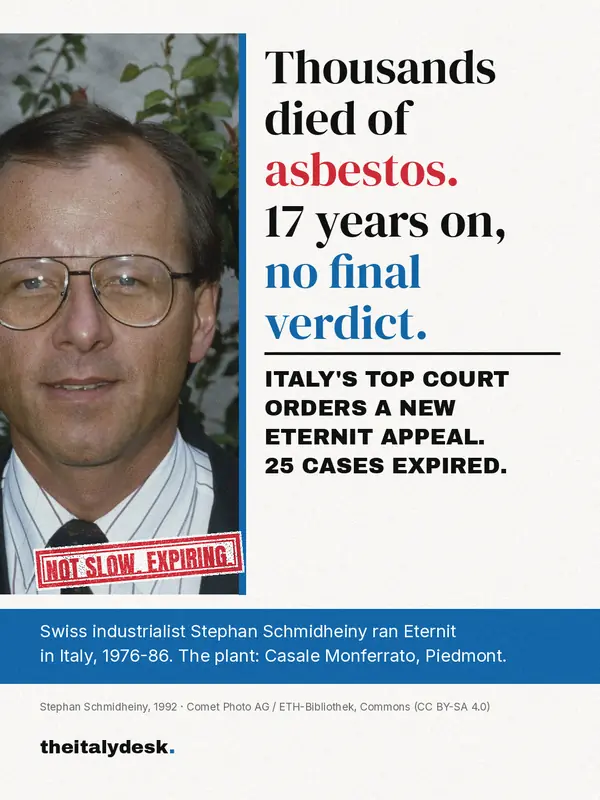
Italy's top court orders a new Eternit asbestos appeal
On 10 November 2026 Italy's top criminal court, the Court of Cassation, threw out a sentence of 9 years and 6 months against Swiss industrialist Stephan Schmidheiny over asbestos deaths in Casale Monferrato, a town in Piedmont, north-west Italy. It ordered a new appeal trial for about 60 victims and declared the charges time-barred for 25 more. The trial began with 392 victims. Seventeen years after the first Eternit trial opened in Turin, no court has reached a final verdict on anyone's criminal responsibility for what happened at the town's asbestos-cement plant. This piece explains what the court decided, how the case got here, and why so many charges have expired along the way.
What the court decided
The fourth criminal section of the Court of Cassation deliberated for more than six hours before reading its ruling on the evening of 10 November, according to ANSA and AGI. It made three decisions:
- For about 60 deaths, it annulled the appeal sentence and sent the case back to a different section of the Assize Court of Appeal in Turin, which will hold a new appeal trial.
- For 25 deaths, it annulled the sentence without a new trial, because the charges had expired under the statute of limitations.
- It did not accept the request of the prosecutor general, the public prosecutor at the Court of Cassation, who had asked it to confirm the sentence. During the hearing the prosecutor general called the defence's procedural objections "inconsistent".
According to ANSA, published by Swiss broadcaster RSI, two cases concerning former workers also expired during the proceedings, and the court rejected the defendant's appeal on those only for the purposes of civil damages.
The written reasons have not been published. Until they are, the court's full reasoning on the 60 cases is not known. We found no date for the new appeal trial.
Who the defendant is
Stephan Schmidheiny, 79, is a Swiss businessman whose family group controlled Eternit's Italian operations. He ran the Casale Monferrato plant from 1976 to 1986, according to RSI and the Swiss news agency Keystone-ATS. He has always denied responsibility and his lawyers have asked for acquittal at every stage. No conviction against him in the Italian asbestos cases is final, so in law he is presumed innocent.
After the ruling, ANSA reported that his defence saw the outcome as a "substantial victory", because of the expired charges and because no criminal liability has been established. A lawyer for the civil parties, the victims' relatives who joined the trial to claim damages, called it "a big disappointment" and said he would challenge the decisions where possible.
The plant and the disease
The Eternit plant in Casale Monferrato opened on 19 March 1907 and closed on 6 June 1986. It made roof sheets and pipes from asbestos cement, a mix of cement and asbestos fibre that was cheap, light and fireproof. Italy banned asbestos with a law passed in 1992.
Asbestos fibres, once breathed in, can cause mesothelioma, a cancer of the lining of the lungs or abdomen. INAIL, the national workplace accident insurance institute, puts the average time between exposure and diagnosis at about 40 years. That is why people are still falling ill in Casale four decades after the plant closed. AFeVA, the association of asbestos victims' families, said this week that clinics in the province of Alessandria see 48 to 50 new mesothelioma patients a year.
Most victims never set foot inside the plant. Of the 392 people named in this trial, 330 were residents and 62 were former workers, according to Il Fatto Quotidiano. Gianni Crisafulli, a former deputy mayor of Casale, puts the town's total toll at about 3,000.
How the case got here
There have been two main criminal cases against Schmidheiny over Casale.
| Date | Court | Outcome |
|---|---|---|
| 13 February 2012 | Turin court | 16 years for intentional environmental disaster (first Eternit trial) |
| 3 June 2013 | Turin Court of Appeal | 18 years and €89 million in damages |
| 19 November 2014 | Court of Cassation | Offence time-barred; conviction and damages cancelled |
| 7 June 2023 | Novara Assize Court | 12 years for aggravated multiple manslaughter, 147 deaths (second trial, "Eternit bis") |
| 17 April 2025 | Turin Assize Court of Appeal | 9 years and 6 months, 91 deaths |
| 11 February 2026 | Court of Cassation | Appeal ruling annulled: never translated into German |
| 10 November 2026 | Court of Cassation | New appeal for about 60 deaths, 25 time-barred |
The first trial was about environmental disaster as a whole, not about individual deaths. In 2014 the Court of Cassation ruled that the offence had expired before the first verdict was even delivered, because it counted the time limit from the plant's closure in 1986. Prosecutors had argued that the disaster was still going on as long as people kept dying. The ruling also cancelled the damages: about 1,000 civil parties had joined that trial, according to the newspaper L'Adige.
Prosecutors in Turin then opened a second case built on individual deaths, initially charging intentional homicide. The Casale strand went to trial in Novara, which convicted Schmidheiny of manslaughter instead. Between the first trial and the appeal, the number of deaths still before the courts fell from 392 named victims to 91, because of acquittals and expired charges, according to AFeVA and ANSA.
The February 2026 annulment was procedural. Schmidheiny's native language is German, and the appeal ruling had not been translated for him. The translation was filed in April 2026, and his lawyers appealed again in May, according to ANSA.
Why so many charges expired
Under the Italian rules that apply to this case, the statute of limitations, called prescrizione, keeps running through all three levels of judgment until a final verdict. Manslaughter, unlike the most serious forms of intentional homicide, has a time limit. When the victims of a disease with a 40-year latency died many years ago, and a trial takes years at each level, the clock can run out before the last court rules. Each new appeal adds time.
Prescription rules have been one of the most contested issues in Italian justice for decades, and governments of different colours have changed them several times. After the 2014 Eternit ruling, then prime minister Matteo Renzi said the rules on prescription had to change. None of the reports we read explained how the later reforms bear on this case, and we could not establish it.
The Eternit case is not the only one to end this way. A sentence over the death of a worker at Eternit's Bagnoli plant in Naples expired in December 2025, according to the Swiss news site tio.ch. A smaller case over the plant in Cavagnolo, near Turin, was annulled by the Court of Cassation in 2024 and again in 2025.
What people said
AFeVA held a sit-in outside the court before the hearing, behind a banner asking for "justice, research, clean-up". Nicola Pondrano, a former Eternit worker, told reporters: "It is a justice that slips away, a real injustice."
In the reports we read, up to the evening of 12 November, we found no statement on the ruling from the government or from national party leaders.
What happens next
- A different section of the Turin Assize Court of Appeal will retry the case for about 60 victims. No date has been set in the reports we read.
- The 25 cases declared time-barred are closed on the criminal side.
- The Court of Cassation still has to publish its written reasons, which will explain why it sent the 60 cases back.
- The site of the plant is now a public park, Parco Eternot, opened in September 2016.
ANSA via RSI, 10 November 2026; AGI, 10 November 2026; Avvenire, 10 November 2026; Il Fatto Quotidiano, 10 November 2026; Sky TG24, 10 November 2026; Renewable Matter, 12 February 2026; tio.ch, December 2025; Il Piccolo, 7 June 2023; AFeVA, Eternit trials 2024; Il Post, 19 and 21 November 2014; L'Adige, 20 November 2014; Il Giornale, November 2014; INAIL; ARPA Piemonte; Regione Piemonte (Parco Eternot); Keystone-ATS.
More in Crime & Justice · Society
Watch the reel on InstagramFound this useful? The Italy Desk is free to read. A small tip helps us keep it that way.
Support us on Ko-fi