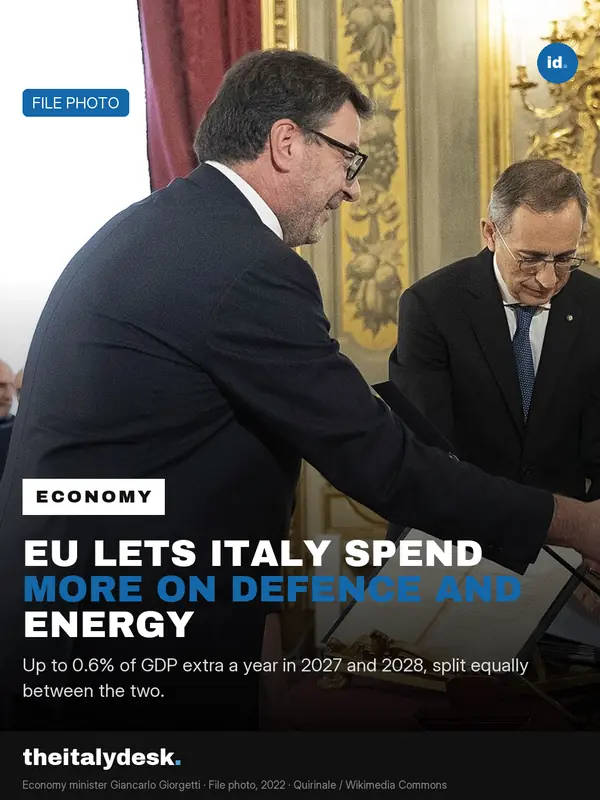
EU lets Italy spend more on defence and energy
On Monday 9 November 2026 the finance ministers of the European Union, meeting as the Ecofin Council, allowed Italy to spend up to 0.6% of its GDP more than EU budget rules would normally permit in each of 2027 and 2028. Half is for defence and half for energy security. Italian media put the total at about €29 billion over two years. It is not EU money: Italy will borrow it. This article explains the rule Italy is using, what the money can be spent on, what it means for Italy's public accounts, and why the decision divides Italian politics.
The rule: a "national escape clause"
Since the reform of the EU's budget rules in 2024, each country has a "net expenditure path": a ceiling, agreed with Brussels, on how fast its public spending can grow each year. Italy has an extra constraint, because it is under an excessive deficit procedure, the EU process for countries whose deficit is above 3% of GDP.
A national escape clause lets a government go above that path for specific purposes without being found in breach of the rules. In 2025 the EU opened it to defence spending as part of its plan to rearm Europe: in July 2025 the Council activated it for 15 countries, with flexibility of up to 1.5% of GDP over four years. Italy did not join that first group.
In June 2026 the European Commission proposed widening the clause to cover energy security, for measures that cut dependence on fossil fuels, within the existing 1.5% ceiling, according to LaPresse. Italy pushed for that change and is now using both parts.
What Italy has been granted
Italy filed its request on 11 September 2026. The Council's recommendation, as reported by Teleborsa and Quotidiano Nazionale:
| Item | Detail |
|---|---|
| Extra spending allowed | Up to 0.6% of GDP in each of 2027 and 2028 |
| In euros | About €14.4 billion a year, €28.8 billion over two years (Quotidiano Nazionale) |
| Defence | Up to 0.3% of GDP a year |
| Energy security | Up to 0.3% of GDP a year |
| Checks | The Commission assesses each energy measure and verifies actual spending afterwards |
| Reporting | Italy sends an update every six months |
These are ceilings, not automatic extra funds. Quotidiano Nazionale notes that part of the spending was already planned.
What the money can be spent on
On defence, the clause covers:
- new multi-year investment programmes in equipment and technology
- higher running costs, including military staff and operations
- purchases financed with loans from SAFE (Security Action for Europe), the EU's defence lending programme
- deliveries after 2028, if the contracts are signed by then and stay within the overall ceiling
In its request, the government said it plans to raise defence spending by up to 0.9 percentage points of GDP by the end of 2028, from 1.3% of GDP in 2024, a level it said would stay broadly flat until 2026.
On energy, the government sent a first list of measures:
- electrification of homes
- energy efficiency in public and private buildings, including schools, universities and hospitals
- solar power and incentives to cut carbon emissions
- railways, public transport and sustainable urban mobility
- renewables, storage, grid flexibility and biofuels
According to QuiFinanza, the energy part is still being discussed with the Commission, and only after its checks will it be clear which measures qualify. Quotidiano Nazionale adds that the clause cannot be used for things outside these areas, such as general pay rises for health workers or pension increases.
What it means for Italy's accounts
The clause changes how the EU counts Italy's spending, not how much Italy actually borrows. The extra money adds to the deficit and to the public debt, and it carries interest.
According to Quotidiano Nazionale, with the 2027 budget the deficit is expected to rise from 2.9% to 3.4% of GDP in 2027, and from 2.7% to 3.2% in 2028, before falling to 2.3% in 2029.
Italy is still under the excessive deficit procedure. In September Istat, the national statistics institute, put the 2025 deficit at about 3.1% of GDP, just above the 3% threshold, so Italy could not leave the procedure this year as the government had hoped. Economy minister Giancarlo Giorgetti said he expects Italy to leave it in 2027, according to L'Espresso. Italy's public debt was 136.7% of GDP in 2025.
What the government says
Giorgetti welcomed the decision. He said the clause lets Italy "strengthen its defence capabilities and energy security" while respecting the recommended spending path and "safeguarding the sustainability of public finances". On the inclusion of energy, he said the government claims it "with strength and pride" and called it "an Italian battle that will be useful to all European countries that want to use it".
Tommaso Foti, minister for European affairs, credited prime minister Giorgia Meloni and said a government led by the opposition would not have asked for the clause, according to Il Giornale.
At the Eurogroup the same day, its president Kyriakos Pierrakakis said that "uncertainty has become the new normal" and that support "must be targeted and temporary".
What the opposition says
The decision divides Italian politics, mostly over defence.
On 5 August 2026 the Chamber of Deputies approved the governing majority's resolution asking the government to start the procedure, with ceilings of 0.6% of GDP for energy and 0.9% for defence. At the request of the League, one of the governing parties, the text says SAFE loans should be used only if they are "overall advantageous", according to Open. The opposition presented separate texts, which were not put to a vote; the Democratic Party (PD) was split, with some of its moderate members distancing themselves from its anti-rearmament wording.
In October, in the Senate, the PD, the Five Star Movement (M5S), the Green and Left Alliance (AVS) and Italia Viva presented a joint resolution that "does not authorise" the roughly €29 billion of extra borrowing for 2027 and 2028. It asked to "radically reconsider" Italy's spending commitments in NATO and to rule out further increases in weapons spending, according to Open. Azione, a centrist opposition party, presented its own text asking that the money go only to investments with a strong impact on growth. Futuro Nazionale, a party outside the governing coalition, proposed limiting defence money to internal security. The government backed the majority's resolution, and the others were not put to a vote.
What happens next
- The 2027 budget law, now in Parliament, sets out how the flexibility is used. It must be approved by 31 December.
- The Commission will assess each energy measure before it counts under the clause.
- Italy will report every six months, and the Commission will check actual spending afterwards.
Teleborsa, 9 November 2026; Quotidiano Nazionale, 9 November 2026; QuiFinanza, 9 November 2026; Il Giornale, 9 November 2026; Council of the EU, Ecofin meeting of 8 July 2025; LaPresse, 3 June 2026; L'Espresso, 22 September 2026; Open, 5 August and 13 October 2026.
More in Economy & Money · Politics · Italy in the World
See the post on InstagramFound this useful? The Italy Desk is free to read. A small tip helps us keep it that way.
Support us on Ko-fi