Mafia in Italy's rich north: less violence, more business
The 'ndrangheta, the crime group born in Calabria, in the toe of Italy, now works in the wealthy north with less violence and more business, according to a report approved on 3 November 2026 by the Italian parliament's anti-mafia commission. The report covers seven northern regions and describes a mafia that sells illegal services to companies willing to buy them. This piece explains what the commission is, what the report says region by region, what courts have already established and what is still only an accusation, and what the commission asks the state to do.
What the commission is
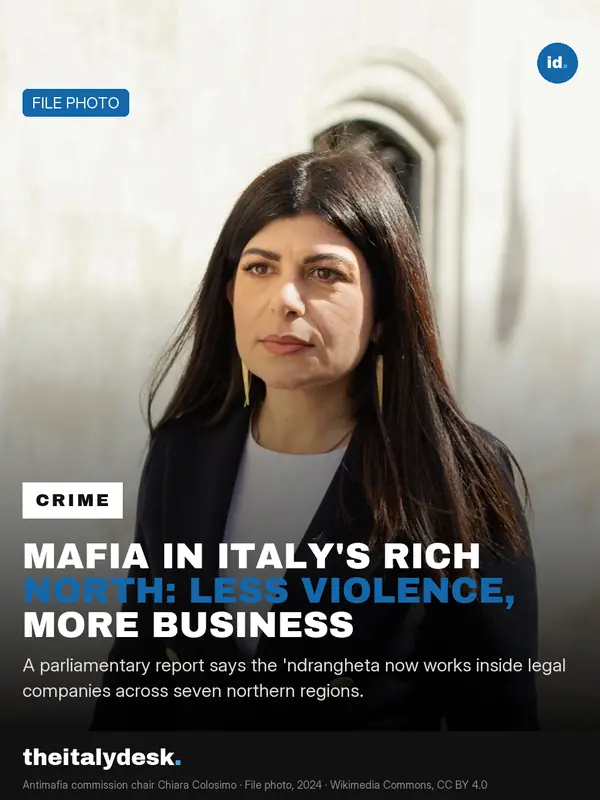
The Parliamentary Commission of Inquiry into Mafias, known in Italy as the Commissione antimafia, is made up of members of both chambers of parliament. It can hear witnesses and acquire documents with the same powers as a judicial authority, and it reports to parliament. Since 2023 it has been chaired by Chiara Colosimo, a member of the Chamber of Deputies for Brothers of Italy (Fratelli d'Italia), the prime minister's party.
The report is titled "'Ndrangheta in northern Italy: the geography of its roots and its new ways of operating". Colosimo was its rapporteur, according to Stato Quotidiano. We could not find the full text online on the evening of 14 November, nor a record of how members voted. This account is based on the summaries published by Corriere della Calabria, Calabria7 and Stato Quotidiano.
The 'ndrangheta is organised in family clans grouped into "locali", local cells that answer to structures in Calabria. In its annual report on 2024, presented to parliament in May 2025, the Anti-Mafia Investigation Directorate (DIA), a police body, counted at least 48 'ndrangheta locali in central and northern Italy.
A mafia that sells services
The report's central idea is that in the north the 'ndrangheta works less by extortion and more as a supplier. It uses the term "mafia mercatista", a market-driven mafia that meets a demand for illegality coming from parts of the formally legal economy. A business owner can be its client, partner or beneficiary, and the relationship can rest on mutual advantage rather than threats.
The services it lists include:
- false invoices and VAT fraud;
- shell companies and nominee owners (front men who hold assets on paper);
- moving cash and laundering money;
- illegal outsourcing of labour;
- managed bankruptcies and the takeover of companies in difficulty.
Firms buy these services, the report says, to cut labour costs, pay less tax, get cash or avoid social security contributions. Over time the exchange can reduce a company's independence until the clan influences its decisions. Professionals, consultants, financial intermediaries and nominees form what the report calls a "grey area" around the clans.
Milan's chief prosecutor, Marcello Viola, is quoted as saying that "it is economic crime that shapes and moulds mafia crime", rather than the other way round. The report adds that violence has not disappeared: "the lower visibility of violence does not mean the intimidating force has gone." It warns that the warning signs are now in tax anomalies, balance sheets, chains of companies, subcontracts and money flows, as well as in arson attacks and threats.
Region by region
| Region | What the report cites |
|---|---|
| Emilia-Romagna | The Grande Aracri clan from Cutro, rooted around Reggio Emilia. The Aemilia trial established an organisation working in Emilia with Calabrian roots, in construction, earthmoving, transport, logistics, waste, restaurants and property. |
| Lombardy | The Crimine-Infinito and Bad Boys investigations, which found 'ndrangheta locali and a regional coordinating body called "Lombardia". The Hydra case (see below). |
| Piedmont | Intimidation and building interests in Bardonecchia from the 1970s; the 1983 murder of Turin's chief prosecutor Bruno Caccia; Bardonecchia's council dissolved in 1995, the first in the north for mafia infiltration; the Minotauro investigation. Today: fake tax credits and outside professionals. |
| Aosta Valley | The Geenna investigation, which established a 'ndrangheta locale in Aosta, confirmed by a final ruling in April 2023. |
| Liguria | The ports of Genoa, Vado Ligure and La Spezia on cocaine routes from South America, with links to Colombia, Ecuador, Peru, Chile, Brazil and Argentina, and Albanian groups working with the clans. |
| Veneto | Presence in the provinces of Verona and Padua and around Venice. The Isola scaligera case found a locale linked to the Arena-Nicoscia clan of Isola di Capo Rizzuto, near Crotone. |
| Trentino-Alto Adige | The Perfido investigation into the porphyry quarries of Trentino, with links to clans from the Reggio Calabria area. |
Some details from the hearings stand out. In Emilia, the report quotes a former member turned state witness, cited in the first-instance Aemilia ruling: "The 'ndrangheta here in Reggio Emilia is autonomous, evolved and technological." In Genoa, prosecutor Nicola Piacente described logistics workers recently arrived from Calabria who helped recover 450 kilograms of cocaine later seized by the Guardia di Finanza, Italy's financial police. He said there was no evidence that shipping companies were involved. In Veneto, prosecutor Bruno Cherchi described clans moving into struggling firms, sometimes taking control of warehouses and production space. In Trentino, former Trento prosecutor Sandro Raimondi said the presence dated back to the 1980s and that members could present themselves as entrepreneurs.
On Aosta, prosecutor Giovanni Bombardieri said the court's finding was "not a point of arrival, but a point of departure".
Hydra: what a judge has found, and what is still on trial
The most far-reaching claim concerns Lombardy. Milan prosecutors in the Hydra investigation allege a stable alliance between members of the 'ndrangheta, Cosa Nostra from Sicily and the Camorra from Naples, working together on drug trafficking, money laundering, tax fraud and financial brokering.
The case has a contested history. In October 2023 the preliminary investigations judge approved only 11 of the 153 arrest warrants prosecutors had requested. The prosecutors appealed, and both the review court and the Court of Cassation, Italy's highest appeal court, later sided with them on the main suspects (L'Espresso).
On 12 January 2026, Milan's preliminary hearing judge ruled on the 80 defendants who had chosen the abbreviated procedure, a fast-track trial decided on the case file in exchange for a reduced sentence. The judge convicted 62, acquitted 18 and handed down sentences of up to 16 years. He found that an association made up of members of the three mafias had operated in Lombardy, which prosecutors call the "Lombard mafia system" (SaronnoNews, L'Espresso).
| Hydra case | Status |
|---|---|
| 80 defendants, abbreviated procedure | First-instance ruling, 12 January 2026: 62 convicted, 18 acquitted |
| 45 defendants, ordinary procedure | Sent to trial, first hearing on 19 March 2026 |
These are first-instance rulings and can be appealed. Under the Italian constitution, defendants are presumed innocent until a final verdict, and the 45 in the ordinary trial have not been judged at all. This is why the commission's report presents the full prosecution account as still under examination by the courts.
What the commission asks for
The report argues that one model of enforcement will not work everywhere, because the 'ndrangheta settles differently in each region. It asks institutions to:
- study local conditions and spot vulnerable sectors early;
- go after illegally obtained assets;
- break the networks of relationships that support the clans;
- remove the advantages that lead business owners to cooperate.
Its main warning is about acceptance. The danger, it says, is that the 'ndrangheta comes to be seen as an ordinary part of economic and social life, and "preventing this normalisation is today a national priority". It calls for "a strategy founded on knowledge, coordination, prevention, economic responsibility and firmness in repression".
What we could not confirm
- The full text of the report and the result of the vote.
- Whether the report gives an updated count of locali in the north: none of the summaries we read cites one.
- Any reaction from the government or from the parties in parliament.
Corriere della Calabria, 3 and 4 November 2026; Calabria7, 3 November 2026; Stato Quotidiano, 3 November 2026; L'Espresso, 27 May 2025 (DIA annual report on 2024) and 13 January 2026 (Hydra ruling); SaronnoNews, 12 January 2026.
More in Crime & Justice · Politics
See the post on InstagramFound this useful? The Italy Desk is free to read. A small tip helps us keep it that way.
Support us on Ko-fi