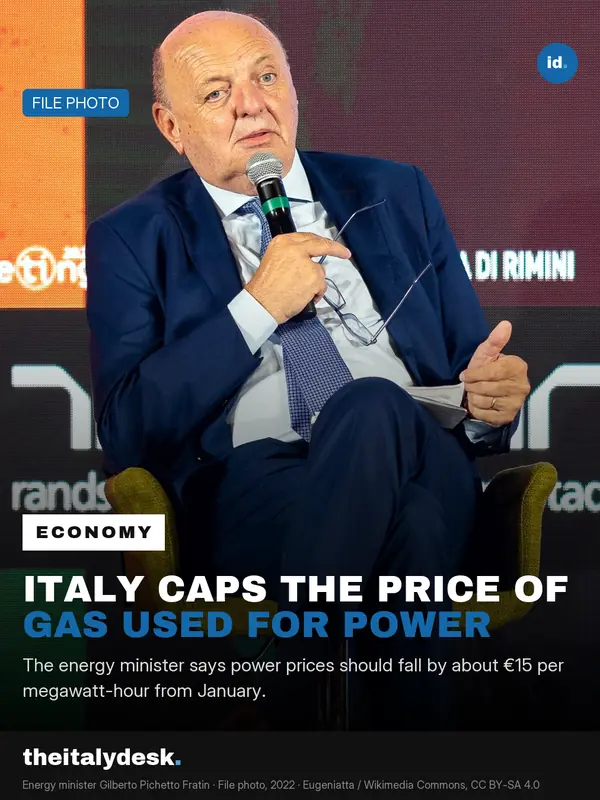
Italy caps the price of gas used to make power
On Monday 9 November 2026 the Italian cabinet approved a decree that caps the price of the gas burned in power plants at €58.9 per megawatt-hour, rounded to €59 by most Italian media. The cap is due to start on 1 January 2027 and to last 18 months. The government says it will lower the wholesale price of electricity by about €15 per megawatt-hour. Independent estimates of what that means for a household bill are much smaller. This article explains why Italy is capping gas to bring down electricity prices, who pays for it, who benefits, and what critics and supporters say.
Why gas sets the price of electricity in Italy
Italy generates a large share of its electricity in gas-fired power plants. On the wholesale market, the price for every hour is set by the most expensive plant needed to meet demand, and in Italy that is usually a gas plant. So when gas gets more expensive, the price of all electricity goes up, including power from solar, wind and hydro plants that do not burn gas at all.
The reference wholesale price is the PUN (Prezzo unico nazionale, the single national price). It directly sets the bill of anyone on a variable-price contract.
Gas is expensive in Europe this autumn. The think tank Ecco put the price at around €100 per megawatt-hour on 8 November, according to Sky TG24; the news site Open cited a European price of €82 the next day. The president of the Eurogroup, the meeting of euro area finance ministers, said on 9 November that European gas remains about three times above pre-war levels. Either way, the market price is well above the cap.
How the cap works
The mechanism is modelled on the "Iberian exception" that Spain and Portugal used during the 2022 energy crisis. Power plants are allowed to count their gas at no more than the capped price when they offer electricity on the market. That should pull the PUN down. The plants are then refunded the difference between the cap and what they actually paid for gas.
The details, as reported by Italian media:
| Item | What is known |
|---|---|
| Cap | €58.9 per megawatt-hour of gas used to make electricity |
| Start | 1 January 2027 |
| Length | 18 months, with a gradual exit at the end (Open); earlier drafts said 12 months, extendable to 18 |
| Model | Spain's 2022 mechanism, agreed with the European Commission |
| Refund to producers | Recovered through a charge on electricity bills |
| Main beneficiaries | About 18 million customers whose price follows the PUN |
| Government estimate | About €15 less per megawatt-hour on the wholesale price |
The European Commission had to agree to the scheme because it affects the single energy market. According to Ecco, quoted by Sky TG24, the EU required a correction so that cheaper Italian power does not distort electricity flows with neighbouring countries. ItaliaOggi notes that this is harder for Italy than it was for Spain, because Italy has more connections with France, Austria and Switzerland.
Who pays
The refund to power plants is paid through a charge (onere) added to electricity bills. According to Corriere della Sera, cited by Open, Brussels asked that only the customers who benefit pay for it. The government says the saving will be bigger than the charge, so the net effect for customers is positive.
How the cost is split was the most disputed point. Earlier drafts, reported by QuiFinanza on 5 November, shared it between bill payers and producers, and estimated the total cost at about €7 billion a year. We could not find the final text of the decree published in the Gazzetta Ufficiale (Italy's official journal) by the evening of 11 November, so the exact split is not confirmed here.
Who benefits
According to Open, the cap mainly helps about 18 million customers:
- vulnerable customers still on the regulated tariff
- customers in the "gradual protection" service, the transitional scheme for households that never chose a supplier on the free market
- customers on the free market with variable-price contracts
Customers on fixed-price contracts will not see a discount for now, according to ItaliaOggi. Prime minister Giorgia Meloni said the largest savings would go to businesses that use a lot of electricity or produce their own.
The rest of the decree
Meloni described the decree as having three parts: the gas cap; stricter rules from ARERA, Italy's energy regulator, against power companies holding back capacity to push prices up, so that cheaper renewable power reaches consumers; and strict limits on passing costs on to customers' bills. Meloni also said the decree cuts the system charges on gas bills, the levies that fund energy policies, by more than €850 million.
A separate measure, meant to use the proceeds from gas stored in 2022 to cut gas bills for energy-intensive companies in 2027, was held back after objections from the Ragioneria Generale dello Stato, the Treasury office that checks public accounts, according to Sky TG24.
How much it could save
The estimates differ widely.
| Source | Estimate |
|---|---|
| Energy minister Gilberto Pichetto Fratin | About €15 less per megawatt-hour on the wholesale price from January; about €30 a year for a family using 2 megawatt-hours (Open) |
| Ecco, climate think tank | About €1.40 a month, or €17 a year, for a household (Sky TG24) |
| Confcommercio, retailers' association | Bills up to 10% lower (Sky TG24) |
| QuiFinanza calculation | About €40 a year for a family using 2,700 kilowatt-hours, if the cut passes through in full |
The savings arrive against a sharp rise in costs. Ecco says the average bill has gone up by more than €30 a month since February. Confcommercio says businesses in the service sector spent €3.8 billion on electricity in the third quarter of 2026, up 46.2% on a year earlier.
What supporters and critics say
Pichetto Fratin called the decree "a first concrete step" for the country, consumers and businesses. Meloni said the benefits are "important" but will take time, and that the government's duty is to protect citizens even if that upsets those who have earned very high profits.
Within the governing coalition, deputy minister Vannia Gava (League) credited the negotiation with the European Commission, and Maurizio Lupi (Noi Moderati) called it another concrete measure against energy costs.
Confcommercio welcomed the cap as a useful tool, especially in an emergency, but not a substitute for structural measures. Confimprenditori, a small-business association, called it a weak measure that comes too late.
Angelo Bonelli of the Green and Left Alliance (AVS), an opposition party, called the household saving a "mocking discount" and said temporary measures do not reduce Italy's dependence on gas. He called for faster growth in renewables, storage and efficiency.
Electricity producers opposed the cap while it was being drafted. Salvatore Pinto, president of the producers' association Elettricità Futura, estimated the cost for the sector at €6 billion to €7 billion and argued that it would penalise customers who chose fixed prices, according to QuiFinanza. ItaliaOggi notes that renewable producers lose margin, because they could previously sell cheap power at prices set by gas.
How the decree got here
This is the second energy-bills decree of 2026. The first, approved in February, included a one-off bonus of €115 for low-income households already receiving the social bonus on their bills, and it became law in April after a confidence vote in the Senate.
The cap took longer. After a preliminary agreement with the European Commission in mid-October, the cabinet was due to approve the decree on 28 October, then on 5 November. Both times it was postponed, the second time after objections from the Ragioneria. It was approved at the third attempt.
What happens next
A decree-law takes effect as soon as it is published in the Gazzetta Ufficiale. Parliament must then convert it into law within 60 days or it lapses, and it can amend it along the way. The cap itself is due to start on 1 January 2027.
Il Fatto Quotidiano, 9 November 2026; Open, 9 November 2026; Sky TG24, 8 November 2026; QuiFinanza, 5 and 9 November 2026; ItaliaOggi, 9 November 2026; Corriere Nazionale, 10 November 2026; Soldionline, 9 November 2026; Facile.it, November 2026; Teleborsa, 9 November 2026; Il Fatto Quotidiano, 8 April 2026.
More in Economy & Money · Politics
See the post on InstagramFound this useful? The Italy Desk is free to read. A small tip helps us keep it that way.
Support us on Ko-fi