Hackers breach the company building the Brenner tunnel
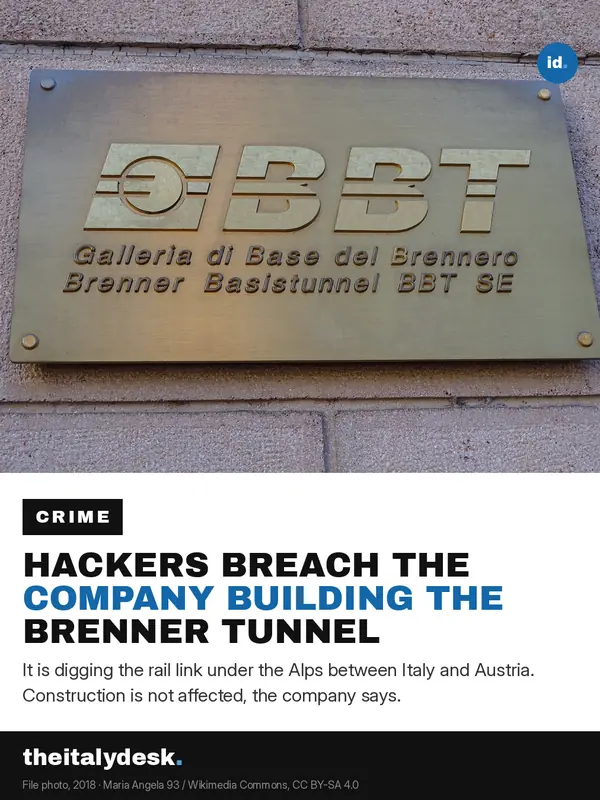
Hackers got into the computer systems of BBT SE, the Italian-Austrian company building the Brenner Base Tunnel, a rail tunnel under the Alps between Austria and Italy. The company confirmed the attack after it was reported by Austrian media on 6 November 2026, and says construction is not affected. An extortion group called Everest is the main suspect, according to the Austrian press and analysts who monitor criminal sites. Here is what has been confirmed, what is only claimed, and why the case is getting attention in a week of other suspicious incidents across Europe.
What happened
The Tiroler Tageszeitung, a daily newspaper in the Austrian region of Tyrol, reported the attack on 6 November. A BBT SE spokesperson, Julia Gruber, confirmed it to the paper. The company later confirmed it to ANSA, Italy's main news agency.
According to BBT SE, unauthorised people accessed some of its data that could be reached over the internet. The company says that once it found the breach it activated its security protocols, isolated the affected systems, hired outside cybersecurity specialists for a forensic analysis and informed the authorities. As far as it currently knows, it says, no operational processes were affected and the building work is not at risk.
Several questions are still open. BBT SE has not said how the attackers got in, which data they took or how much. It has not answered questions about whether it was asked for money, whether it negotiated, or whether it paid.
In Italy the investigation is being handled by the Polizia Postale in Bolzano, the police unit that deals with cybercrime, according to il Giornale. Austrian media report that the authorities there have also been informed. No prosecutor's office has publicly commented on the case in the sources we checked.
The timeline
| Date | Event | Source |
|---|---|---|
| Mid-October 2026 | Intrusion into BBT SE systems | Tiroler Tageszeitung, press reconstructions |
| 17 October 2026 | Everest lists BBT SE on its site on the dark web | Breachsense, Dexpose |
| 6 November 2026 | Attack made public by the Austrian press | Tiroler Tageszeitung, ORF Tirol |
| 7 November 2026 | BBT SE confirms the attack to ANSA | ANSA, il Giornale |
The dark web is a part of the internet that ordinary search engines do not reach and that is used, among other things, to sell or publish stolen data.
Who is suspected
The Tiroler Tageszeitung, citing an analysis by the US cybersecurity company ZeroFox, wrote that a Russian-speaking group called Everest may be behind the attack. Groups of this kind steal data, threaten to publish it and ask for money to keep it private. This is a reconstruction by the press and by private analysts. The authorities have not confirmed who carried out the attack.
Breachsense, a service that tracks criminal leak sites, says Everest claims to have taken 812 gigabytes of data from BBT SE. Breachsense says it has not verified the claim. Cyber Security 360, an Italian specialist site, notes that some reports put the haul at about 460,000 files, a figure the company has not confirmed. The same site says that ZeroFox, in a report from February 2026, found that Everest tends to exaggerate the size and sensitivity of what it steals.
Everest first appeared in December 2020, according to the security news site Help Net Security. It started with data theft and later moved into ransomware, where attackers lock a victim's systems, and into selling access to hacked networks to other criminals.
The group has already targeted the rail sector. In July 2026, Stadler, a Swiss maker of trains, said Everest had demanded 10 million Swiss francs (about 12.3 million US dollars) after getting into a data platform it shared with a supplier, using stolen login details. Stadler said its own systems and production were not affected, refused to pay and filed a complaint with the police in the Swiss canton of Thurgau.
There is no public evidence that the Russian state ordered the attack on BBT SE. Everest is described as a criminal group that works for money. Cyber Security 360 warns against assuming a state link without proof.
What the tunnel is
The Brenner Base Tunnel will run from Innsbruck in Austria to Fortezza (Franzensfeste in German) in the Italian province of Bolzano, in South Tyrol. Including the existing rail bypass around Innsbruck, it measures about 64 kilometres, which would make it the longest underground rail link in the world. It is meant to move freight from trucks to trains on the Brenner Pass, one of the busiest routes across the Alps, and to cut the train journey between Innsbruck and Fortezza from about 80 minutes to about 25.
BBT SE is a European company jointly owned by the Austrian and Italian sides. The European Union pays part of the cost: according to the project's figures summarised on Wikipedia, it covered half of the exploratory tunnel and 40% of the two main tubes between 2015 and 2023, with Austria and Italy splitting the rest.
The project has passed key points this year and last. The exploratory tunnel broke through at the border on 18 September 2025, and the two main tubes were joined at 10:35 on 28 July 2026, about 1,400 metres below the Brenner Pass, according to Teleborsa.
On 21 October 2026, a few days after the intrusion, BBT SE announced that the tunnel would open in 2034, later than planned, and that the cost forecast had risen from 10.5 billion euros to about 11.7 billion. The company gave changes to the design and safety rules, higher prices for rail equipment and a longer building period as reasons. There is no sign that the delay is linked to the attack.
Why it matters
The value of stolen engineering files depends on whether they are real, complete and current. Cyber Security 360 lists drawings, surveys and construction procedures as the kind of documents a leak like this could include, but nothing has been published or verified so far. The site also notes that older documents may describe a design that has since changed.
The case also raises a legal question. NIS2, the EU directive on the security of networks and information systems, covers operators of rail infrastructure. Cyber Security 360 points out that it still needs to be checked whether a company that is building a tunnel, not yet running it, falls under the same rules.
A week of incidents
The attack became public in a week when European governments were already dealing with other suspicious events:
- Hoax bomb threats hit dozens of flights across Europe, including a Wizz Air flight from Prague to Rome that was diverted to Venice. Italian Prime Minister Giorgia Meloni said: "Today we are not in a position to say whether these events are all connected." The EU transport commissioner, Apostolos Tzitzikostas, said security experts would meet in Brussels the following week.
- A pro-Russian hacker group, NoName057(16), published personal data about Italy's foreign minister, Antonio Tajani, and offered money for information on 18 people.
- Earlier in the month, refrigerated displays in some Sicilian supermarkets were tampered with remotely.
No investigator has publicly linked these incidents to the attack on BBT SE, and this article does not suggest a connection. Some Italian media, including Il Messaggero, have framed the attack as part of a "hybrid war", a term for hostile actions that stay below open military conflict. That is a reading, not an established finding.
This is a developing story: this article reflects what was known on the evening of 8 November 2026.
Tiroler Tageszeitung (6 November 2026); ORF Tirol (6 November 2026); Der Standard; Heute (7 November 2026); il Giornale (7 November 2026, with BBT SE's statement to ANSA); Cyber Security 360 (7 November 2026); blue News (statement by Julia Gruber, Breachsense data); Breachsense, Everest claim on BBT SE (17 October 2026); Dexpose (17 October 2026); Help Net Security on Stadler and Everest (23 July 2026); Railway News on BBT SE's new schedule and costs (28 October 2026); Teleborsa on the main tunnel breakthrough (28 July 2026); Wikipedia entry on the Brenner Base Tunnel for length and EU funding; AP via The Week on the bomb threats (7 November 2026); Il Messaggero (headline on the attack).
More in Crime & Justice · Italy in the World
See the post on InstagramFound this useful? The Italy Desk is free to read. A small tip helps us keep it that way.
Support us on Ko-fi