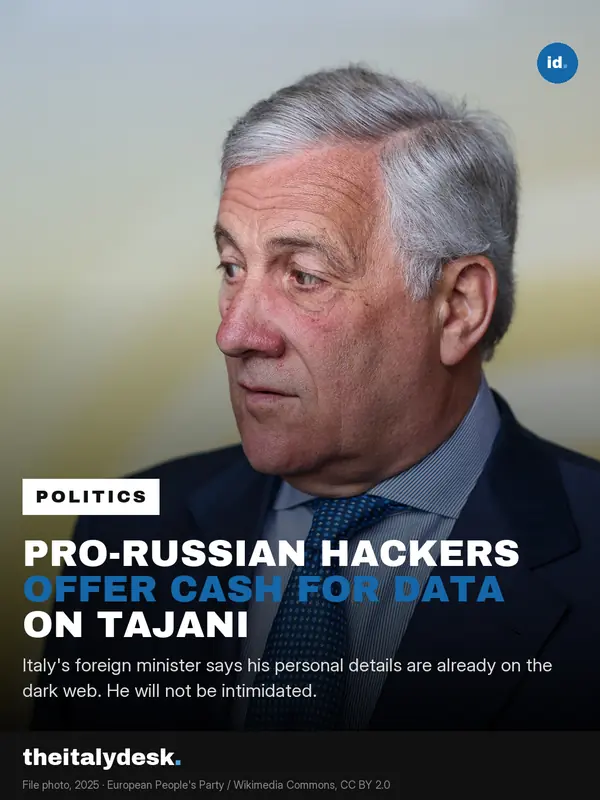
Pro-Russian hackers offer cash for data on Tajani
A pro-Russian hacker group has published personal details of Italy's foreign minister, Antonio Tajani, and his family on the dark web, and since 26 October it has been offering money for information on 18 people it calls enemies of Russia. Several of them hold senior posts in police and judicial bodies that took part in a 2025 international operation against the group. Rome prosecutors have opened an investigation. Here is what is known about the list, who is behind it, why these names may have been chosen and what remains unconfirmed.
What happened
Tajani, who is also deputy prime minister and leader of the centre-right party Forza Italia, wrote on X on 7 November that cybercriminals had spread personal data about him and his family on the dark web. The dark web is a part of the internet that ordinary search engines do not index and that is reached through special software, often used to sell stolen data. "I will not be intimidated in any way," he wrote. He said Italy's position on Ukraine was "the political reason" he had been targeted. That is his assessment, not a finding of the investigators.
The details come from Il Fatto Quotidiano, which first reported the story, and were taken up by the ANSA news agency. According to those reports, the group NoName057(16) has been publishing data and asking for paid tips for at least two weeks. On 26 October it put a "bounty" on 18 people. Each profile includes a CV, public information, private phone numbers, email addresses and home addresses. Il Fatto reported that the page was still online because no one had taken it down. The amounts offered have not been published in the reports we checked.
Who is on the list
The reports name eight of the 18 people. The other ten have not been made public.
| Name | Role | Country |
|---|---|---|
| Antonio Tajani | Foreign minister and deputy prime minister | Italy |
| Francesco Lo Voi | Chief prosecutor of Rome | Italy |
| Ivano Gabrielli | Head of the Polizia Postale, the police unit for cybercrime | Italy |
| Paolo Tassan-Zanin | Mayor of Aviano, home to a US Air Force base | Italy |
| Michael Schmid | President of Eurojust, the EU agency for judicial cooperation | EU |
| Benjamin Krause | Prosecutor in Frankfurt | Germany |
| Holger Münch | Head of the Federal Criminal Police Office (BKA) | Germany |
ANSA also lists a German investigative journalist who is wanted by the Russian authorities. Diario del Web, citing Il Fatto and Il Sole 24 Ore, reports that three German investigative journalists are on the list.
According to Diario del Web, the mayor of Aviano, a town in north-east Italy, reported the threat to the Polizia Postale. The town has strengthened its cybersecurity, and the mayor said he did not need personal protection.
Who NoName057(16) is
NoName057(16) appeared in March 2022, shortly after Russia's full-scale invasion of Ukraine, with attacks on Ukrainian news sites. It specialises in DDoS attacks (distributed denial of service). In a DDoS attack, thousands of computers send requests to a website at the same time until it slows down or goes offline. It does not usually involve stealing data. The group recruits volunteers through the messaging app Telegram and gives them its own attack software, called DDoSia. Investigators counted more than 4,000 supporters.
Italy has been a frequent target. In February and March 2023, after Prime Minister Giorgia Meloni visited Kyiv, the group attacked the websites of Italian companies and institutions; on 22 March 2023 the site of the transport ministry went offline. In February 2026, during preparations for the Milan-Cortina Winter Olympics, it claimed a DDoS attack on a hotel website in Cortina, SmartWorld reported. Tajani said at the time that attacks on foreign ministry sites that week were of Russian origin.
ANSA describes the group as "considered linked" to the GRU, Russia's military intelligence service. We did not find an official attribution by a government or police agency confirming that link. Russia has not commented on the list in the reports we checked.
Why these names
Several names on the list match the investigation that hit the group last year. In July 2025 Operation Eastwood, coordinated by Eurojust with Europol, the EU police agency, took place in 12 countries, including Italy. According to Eurojust's figures, reported by Diario del Web and InCyber:
- more than 100 servers were taken offline, a large part of the group's core infrastructure;
- seven international arrest warrants were issued, mostly for suspects reported to be Russian citizens or residents of Russia;
- there were two arrests and 24 searches, five of them in Italy, where four people were questioned;
- investigators contacted more than 1,100 supporters through the group's channels and warned them of the legal consequences.
The head of Eurojust, a Frankfurt prosecutor, the head of Germany's federal criminal police, Rome's chief prosecutor and the head of Italy's cybercrime police all appear on the list. The link with Operation Eastwood is drawn by the press. Diario del Web notes that the official statements on the operation do not connect any of these people to it, and no authority has confirmed why they were chosen.
The move is also a change of method. A DDoS attack takes a website down for a few hours. A list with home addresses and a reward for more information puts pressure on individual people and their families.
Reactions
Prime Minister Meloni expressed her "full solidarity" with Tajani and said that the sale of confidential information about people in public institutions was a cause of "great concern", ANSA reported. Rome prosecutors are investigating. We did not find statements from opposition leaders on the list in the reports we checked by the evening of 7 November.
A busy week for Italian cybersecurity
The list emerged in a week of other incidents, which have not been linked to each other or to NoName057(16):
- BBT SE, the company building the Brenner Base Tunnel between Italy and Austria, said unauthorised people accessed some of its data on 17 October. The Austrian newspaper Tiroler Tageszeitung reported that investigators are looking at Everest, a Russian-speaking cybercrime group. The company said its work was not affected.
- Hoax bomb threats, sent by email in Italian, hit 35 flights across Europe on 3, 5 and 6 November, according to Eurocontrol, Europe's air traffic network manager. The Financial Times reported that some European intelligence officials think a Russian origin is more likely. That has not been established.
- Earlier this month, refrigerated displays in some Sicilian supermarkets were tampered with remotely, part of a wave of similar incidents in other European countries.
This is a developing story: this article reflects what was known on the evening of 7 November 2026.
Antonio Tajani on X (7 November 2026); Il Fatto Quotidiano via ANSA (7 November 2026); ANSA (7 November 2026, including statements by Giorgia Meloni, the Brenner tunnel attack and Eurocontrol data); Diario del Web (7 November 2026); Eurojust and Europol on Operation Eastwood (July 2025), as reported by InCyber (21 July 2025); SmartWorld (4 February 2026); Wikipedia entry on NoName057(16) for the 2022 and 2023 attacks.
More in Politics · Crime & Justice · Italy in the World
See the post on InstagramFound this useful? The Italy Desk is free to read. A small tip helps us keep it that way.
Support us on Ko-fi