Italy's government challenges Veneto's assisted dying law
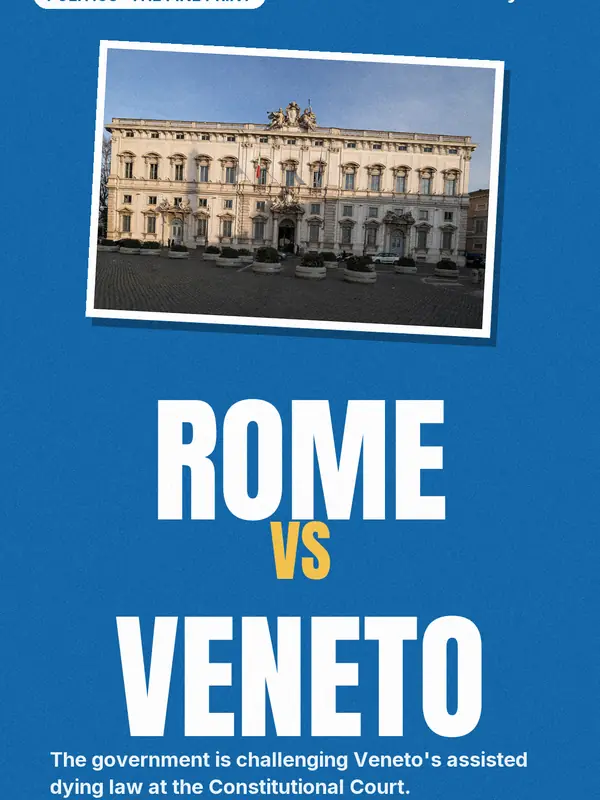
Italy's government has asked the Constitutional Court to strike down a law on assisted dying passed by Veneto, the north-eastern region around Venice. Veneto is run by the League, one of the three main parties in the governing coalition, and the cabinet did not decide unanimously: on 5 November 2026 one League minister voted against the challenge and the party's leader stayed out of the vote. Veneto is the fourth region to pass such a law and the fourth to see it challenged. This article explains what Italian law allows, what Veneto's law says, why the government objects and what the Court decided on similar laws.
What Italian law allows
Italy has no national law on assisted dying. Helping someone end their own life is a crime under article 580 of the Criminal Code. In 2019, in ruling 242, the Constitutional Court decided that it is not punishable when the person:
- has an illness that cannot be cured;
- is suffering, physically or psychologically, in a way they find intolerable;
- is kept alive by life-sustaining treatment;
- is fully able to make free and informed decisions.
A public health facility has to check those conditions, after an opinion from the local ethics committee. The Court asked Parliament to write a law, and Parliament has not. Later rulings, in 2024 and 2025, widened what counts as life-sustaining treatment (Pagella Politica, an Italian fact-checking site). The patient must take the drug themselves. A doctor administering it, which is what most countries call euthanasia, is still a crime.
The rulings do not say who receives a request or how long the checks may take. Regions run the public health service, so some have written their own procedures.
What Veneto's law says
The regional council passed the law on 2 September 2026 by 32 votes to 14, with 5 abstentions. It became regional law no. 17 of 8 September 2026, "Procedures for regional health care for medically assisted suicide". It started from a bill drafted by the Luca Coscioni Association, which campaigns for legal assisted dying.
The League and Forza Italia, both centre-right, voted mostly in favour, with some members against. The centre-left opposition also voted in favour. Brothers of Italy, the party of Prime Minister Giorgia Meloni, voted against as a bloc, as did the one councillor of Futuro Nazionale, the party founded by General Roberto Vannacci (Il Post). In 2024 the same council had rejected a similar bill by a single vote.
According to Pagella Politica, which saw the approved text, the law says:
- Each local health authority (ULSS) sets up a permanent medical commission of nine members with different specialities. It must include a palliative care doctor, and members who disagree with that doctor have to explain why (Il Post).
- The commission checks that the patient was told about palliative care, including deep sedation, and about the right to refuse or stop any treatment. Psychological support is offered.
- The commission's opinion goes to the ethics committee. If the requirements are met, the commission sets the drug and how the patient will take it. Health staff take part only if they volunteer.
- The original bill had fixed deadlines. The final text has none: the procedure must start promptly and go ahead "without unjustified delay".
- The procedure is free and paid for from the existing regional health budget.
Alberto Stefani, the League governor of Veneto, signed ten amendments that he says rewrote the text in the direction of "favor vitae", a legal phrase meaning a presumption in favour of life.
Why the government challenged it
The government can refer a regional law to the Constitutional Court within 60 days of its publication if it believes the region has overstepped its powers. The cabinet's statement says it is challenging the Veneto law "in relation to a series of constitutional parameters, in particular articles 2, 3, 32, 97, 117 and 123 of the Constitution". They cover, in order, inviolable rights, equality, health, public administration, the split of powers between State and regions, and regional statutes.
The appeal itself was not public when we checked, so we cannot say which provisions it targets. In its earlier challenges the government argued that rules on assisted suicide belong to the State and not to the regions (Il Post).
A challenge does not by itself suspend a regional law. The Court can suspend it if asked, and we found no report that the government had asked.
A split inside the government
Ministers did not agree. According to Avvenire and Pagella Politica:
- Roberto Calderoli, the minister for regional affairs and a League member, voted against. He described the Veneto text as a law that only sets out guidelines, unlike the laws of Tuscany, Emilia-Romagna and Sardinia (AGI).
- Matteo Salvini, deputy prime minister and League leader, took no part in the discussion or the vote.
- Economy Minister Giancarlo Giorgetti and Minister Alessandra Locatelli, both from the League, and Health Minister Orazio Schillaci were also absent (Avvenire).
- Forza Italia, led by Foreign Minister Antonio Tajani, had its position put on record: a matter this delicate needs a national law from Parliament, to avoid conflicting regional rules.
In Veneto, Stefani says his region's law is "substantially different" from those passed by centre-left regions and expects it to survive the Court's review. Luca Zaia, governor from 2010 to 2025 and now president of the regional council, pushed for the law and voted for it. He said he "fully respects" the government's decision, which he called a constitutional prerogative, and added: "The real problem is that Parliament does not legislate."
Outside the government, Marco Cappato of the Luca Coscioni Association said the association trusts the Constitutional Court, and accused the majority of blocking its popular-initiative bill on legal euthanasia in Parliament (L'Espresso). In September, when the law passed, the Patriarch of Venice, the city's Catholic archbishop, warned of the risk of a "drift" (Avvenire).
What the Court said about the other regions
The Court has already ruled twice on laws like this one.
| Region | Law | Challenged | Outcome |
|---|---|---|---|
| Tuscany | Regional law 16 of 14 March 2025 | Yes | Ruling 204/2025, published 30 December 2025: law kept, several provisions struck down |
| Sardinia | Regional law 26 of 18 September 2025 | Yes, November 2025 | Ruling 148/2026, filed 24 July 2026: law kept, several provisions struck down |
| Emilia-Romagna | Passed July 2026 | Yes, 24 September 2026 | Pending |
| Veneto | Regional law 17 of 8 September 2026 | Yes, 5 November 2026 | Pending |
In both rulings the Court rejected the government's argument that the whole law was beyond a region's powers. Organising how local health services handle requests falls under health protection, a power the Constitution shares between the State and the regions, and the lack of a national law does not stop a region from using it.
It also set limits. A region cannot write the access conditions into its own law, even by referring to the Court's rulings, because those rulings changed civil and criminal law, which belong to the State alone, and they can change again. It cannot set deadlines so tight that they prevent thorough clinical and psychological checks: the 30-day limit in the Sardinian law was struck down. It cannot require local health authorities to provide the drug and help with taking it, which is why parts of both laws fell. The Sardinian ruling also says that no doctor is obliged to take part.
The Veneto text has no fixed deadlines, one of the points on which both earlier laws lost provisions. Whether the rest of it stays within the limits the Court has drawn is what the Court will now decide.
Where the national bill stands
The governing majority's bill, drafted by Senators Pierantonio Zanettin of Forza Italia and Ignazio Zullo of Brothers of Italy, is the base text in the Senate's justice and health committees. On 3 June 2026 the Senate voted 88 to 59 to send an opposition bill, led by Alfredo Bazoli of the Democratic Party, back to committee. Forza Italia said at the time that the majority's text was not yet ready (Open). The main dispute is how far the national health service should be involved: the Democratic Party, the Five Star Movement and the Greens and Left Alliance want it to have a full role. In November the majority bill was still in committee (Avvenire).
What happens next
- The Court has not set a hearing date that we could find. In the Sardinian case, about eight months passed between the government's appeal and the ruling.
- Until the Court rules, the Veneto law stays in force unless the Court suspends it.
- If Parliament passes a national law first, the regional laws would have to fit within it.
Council of Ministers statement, 5 November 2026 (via Agenparl); Constitutional Court, rulings 242/2019 and 148/2026 (cortecostituzionale.it); Il Post, 2 September 2026; Pagella Politica, September and 6 November 2026; Avvenire, September and 5 November 2026; AGI, 5 November 2026; L'Espresso, 6 November 2026; ItaliaOggi on ruling 204/2025; Open, 3 June 2026.
Found this useful? The Italy Desk is free to read. A small tip helps us keep it that way.
Support us on Ko-fi