Italy buys more olive oil than its groves produce
Italy is famous for its olive oil, yet it does not grow enough of it. In a normal year Italian groves produce around 300,000 tonnes, while the country needs about 470,000, and Italy also sells oil abroad. To cover the gap it imports more than half a million tonnes a year, mostly from Spain, according to a survey published in February 2026 by the Mediobanca Research Area, the research arm of the Milan investment bank. This piece explains where the oil comes from, how Italy re-exports it, what the label on the back of a bottle tells you, and what has changed since the survey came out.
How much Italy grows
Italian production swings a lot from one year to the next, because olive trees tend to alternate heavy and light harvests and because drought and heat hit the south, where most groves are. These are the figures of the International Olive Council (IOC), the intergovernmental body for the sector, as reported by Tasting Life:
| Season (October to September) | Italian production |
|---|---|
| 2020/21 | 274,000 tonnes |
| 2021/22 | 329,000 tonnes |
| 2022/23 | 241,000 tonnes |
| 2023/24 | 328,000 tonnes |
| 2024/25 | 248,000 tonnes |
| 2025/26 | 325,000 tonnes |
In February, Mediobanca expected about 300,000 tonnes for 2025/26. Ismea, the public agency that monitors Italian farm markets, later put the season at 325,000 tonnes, 31% more than the year before.
On the other side of the balance, Mediobanca puts Italy's yearly needs at about 470,000 tonnes. Demand is not fixed: in 2024/25, a year of very high prices, Italian consumption fell 4% to under 400,000 tonnes, and Spain overtook Italy as the world's biggest consumer, according to the same survey as reported by L'Unione Sarda.
Where the imports come from
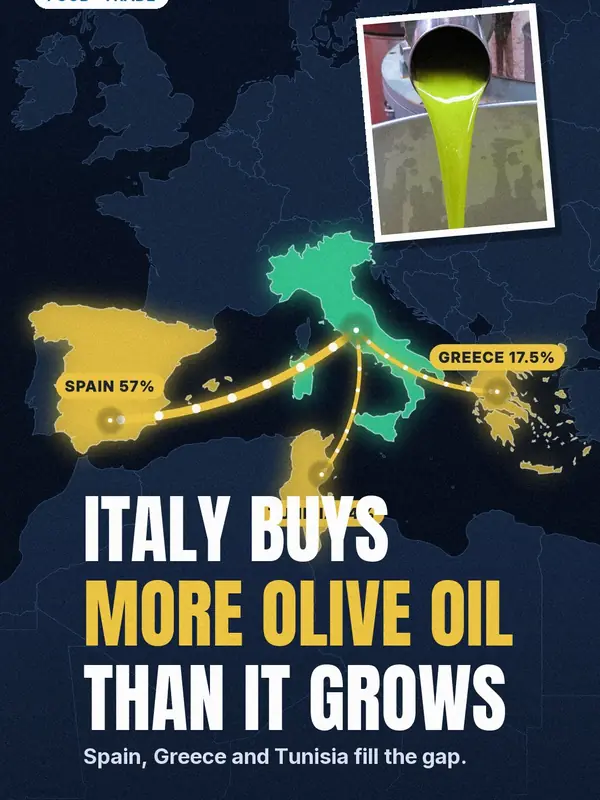
For the 2025/26 season Mediobanca expected Italian imports of 570,900 tonnes. The suppliers:
- Spain: 56.8%
- Greece: 17.5%
- Tunisia: 14%
In 2024 Italy spent €2.9 billion on imported olive oil, the second biggest bill in the world after the United States (€3 billion) and well ahead of Spain (€1.4 billion), the survey says.
Price is part of the reason. In November 2025 extra virgin oil cost €7.58 a kilo at the wholesale market in Bari, in Puglia, Italy's main producing region. The same grade cost €5.05 in Greece, €4.54 in Spain and €3.68 in Tunisia. Italian oil was 1.5 times the Greek price, 1.7 times the Spanish and 2.1 times the Tunisian, according to Mediobanca.
Tunisia matters beyond Italy. It is by far the European Union's largest supplier from outside the bloc: between October 2025 and March 2026 it accounted for 81% of the EU's olive oil imports from non-EU countries, according to European Commission data reported by Euronews.
A hub as well as a producer
Italy does not just consume what it imports. Bulk oil arrives by tanker, is blended and bottled by Italian companies and leaves again under Italian brand names. In 2024 Italy exported close to 300,000 tonnes, 7.8% less than the year before. About half went to three countries:
| Destination | Share of Italian exports (by volume, 2024) |
|---|---|
| United States | 32.2% |
| Germany | 14% |
| France | 6.8% |
By value, Italian exports were worth €2.8 billion in 2024, second only to Spain (€5.1 billion). Because Italy imports and exports roughly the same amount in euros, its olive oil trade balance is usually close to zero but negative: minus €19 million in 2024, against an average of minus €171 million a year since 1991, Mediobanca calculated. For 2025/26 the survey expected exports of 371,000 tonnes.
The United States, the biggest buyer, has become harder. Istat data reported by Askanews show that in the first eleven months of 2025 Italian olive oil exports to the US fell 26.6% in value while volumes rose 1.1%, and Askanews linked the fall to the first effects of US tariffs. In the first half of 2026, exports to the US were down 15%, QuiFinanza reported, while sales to the United Kingdom, the Netherlands and Poland grew.
None of this trade is illegal. Blending oils from different countries is allowed, as long as the label says so.
How to read the label
EU rules, set out in Commission Delegated Regulation (EU) 2022/2104, make the origin compulsory on extra virgin and virgin olive oil. On the lower grades, "olive oil composed of refined and virgin olive oils" and olive pomace oil, an origin is not allowed at all. For the two top grades, the back label says one of these things:
- A single country, such as "Italy" or "Spain": the olives were harvested and pressed in that country.
- "Blend of olive oils of European Union origin": the oil can come from any EU country, Italy included.
- "Blend of olive oils not of European Union origin": all of it comes from outside the EU, for example Tunisia or Turkey.
- "Blend of olive oils of European Union origin and not of European Union origin": part of it comes from inside the EU and part from outside.
- If the olives were picked in one country and pressed in another, the label has to say both.
Names of Italian regions or areas are a different matter. Under EU rules they can appear only on oils registered as PDO or PGI (in Italian DOP and IGP), which tie the oil to a specific territory and production method. Italy has 42 PDO and 8 PGI olive oils, according to Mediobanca.
A brand name is not an origin. An Italian-sounding brand, or an Italian company address, tells you who bottled the oil, not where the olives grew.
How much of the oil in Italian storage is Italian
Every Italian mill, bottler and trader has to record its oil in an online register, the registro telematico dell'olio, run by ICQRF, the agriculture ministry's food fraud inspectorate. The register gives a regular snapshot of the oil sitting in Italian tanks.
On 30 June 2025, after a poor Italian harvest, oil of Italian origin was 42.1% of the extra virgin in storage and oil from other EU countries 47.2%, according to the register data reported by QuiFinanza at the time.
A year later the picture had shifted, thanks to the bigger 2025/26 harvest. On 30 September 2026, at the end of the season, Italy held 195,044 tonnes of olive oil, of which 150,203 tonnes were extra virgin, according to ICQRF's Frantoio Italia report as reported by QuiFinanza. Italian-origin oil made up 54.7% of the extra virgin (82,195 tonnes), oil from other EU countries 35% (52,600 tonnes), non-EU oil 5,418 tonnes and blends 9,990 tonnes.
What has changed since February
- More Italian oil, lower prices. With the larger 2025/26 harvest, imports fell in the first six months of 2026, Ismea said in September. Prices dropped too: Ismea figures reported by QuiFinanza put the average farm-gate price of Italian extra virgin at about €4.82 a kilo in 2026, against €9.47 in 2025. Spanish, Greek and Tunisian oil was trading at roughly €3.40 to €3.75 a kilo in July, according to Olio Officina.
- A smaller harvest ahead. For 2026/27, Federolio, the association of oil traders and bottlers, expects Italian production to fall by about 20%, with Sicily, Puglia and southern Calabria hit hardest. Assitol, the olive oil industry association, estimated on 26 October about 260,000 tonnes.
- A record in Spain. Assitol says Spain expects a record 1.6 million tonnes this season, more than six times Italy's estimate, which is already pushing international prices down.
A smaller Italian harvest next to a record Spanish one points to more imports this season, not fewer. How many will only be clear from the official figures, after the season closes at the end of September 2027.
Mediobanca Research Area, olive oil survey, February 2026 (via MF Newswires, 18 February 2026, and L'Unione Sarda, 1 March 2026); International Olive Council and Federolio (via Tasting Life, 16 September 2026); Ismea at Terra Madre Salone del Gusto, 24 September 2026 (via UCI and QuiFinanza, 3 October 2026); Assitol (via Arsiam, 28 October 2026); Commission Delegated Regulation (EU) 2022/2104, art. 8 (EUR-Lex; summary in Food Times); ICQRF, Frantoio Italia report, 9 October 2026 (via QuiFinanza, 18 October 2026); registri telematici dell'olio, 30 June 2025 (via QuiFinanza, July 2025); Istat via Askanews, 19 February 2026; European Commission data via Euronews, 7 July 2026; Olio Officina, July 2026.
More in Economy & Money · Culture
Watch the reel on InstagramFound this useful? The Italy Desk is free to read. A small tip helps us keep it that way.
Support us on Ko-fi