A boy of 15 was lynched after a shot at Mussolini
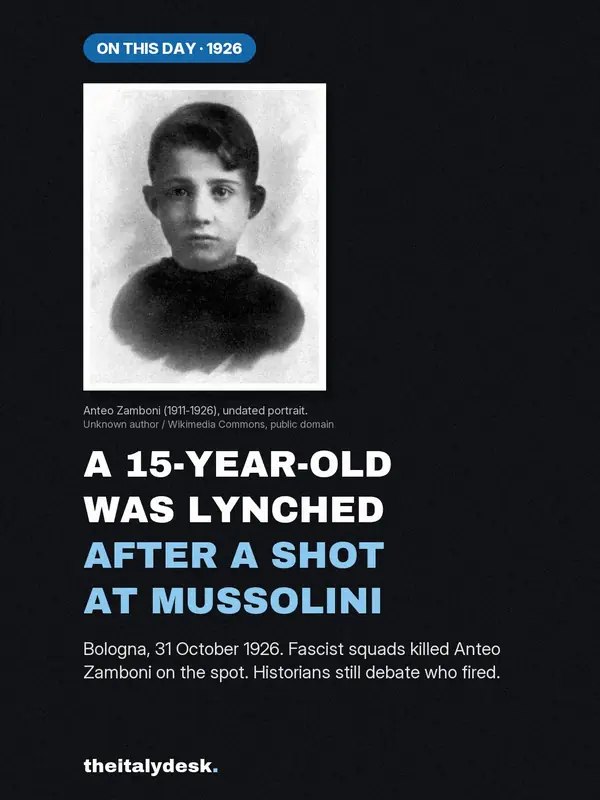
On 31 October 1926, in the centre of Bologna, someone fired a pistol at Benito Mussolini. He was unhurt. Within minutes a 15-year-old boy, Anteo Zamboni, had been seized in the crowd and killed by Fascist militiamen. A hundred years later, historians still disagree on whether he fired the shot, and the city has just restored his tomb and put a new plaque on his family's house. This piece explains what is known about that afternoon, what remains disputed, how the regime used the attack, and how Bologna remembers it.
The afternoon of 31 October
Mussolini, the head of government since the March on Rome of October 1922, the show of force that brought the Fascists to power, came to Bologna for the fourth anniversary of that event. He also opened the city's new stadium, the Littoriale, known today as the Stadio Renato Dall'Ara, where Bologna FC still plays.
Shortly after 5.30 pm, his open car was heading for the railway station along via dell'Indipendenza, near Palazzo Re Enzo, one of the buildings on the city's central squares. The car, a red Alfa Romeo, was driven by Leandro Arpinati, the leader of Bologna's Fascists. A shot came from the crowd. According to the Italian news agency AGI, the bullet went through the sash Mussolini was wearing and lodged in the seat. He was not injured.
Soldiers on security duty and bystanders grabbed Anteo Zamboni. One of them was Carlo Alberto Pasolini, the father of the future film director Pier Paolo Pasolini; the Fondazione Micheletti, a historical institute in Brescia, describes him as a sergeant who disarmed the boy, while AGI calls him a lieutenant of the 56th Infantry who blocked him. Blackshirts, as the members of the Fascist militia were known, then attacked Anteo. At the morgue, according to both sources, his body had fourteen stab wounds, a gunshot wound and signs of strangulation.
Who Anteo Zamboni was
Anteo was born in Bologna on 1 February 1911. He left school after the fifth grade and worked as an apprentice in his father's print shop. The details of his background are part of what makes the case hard to read:
- From 1923 until the spring of 1926 he was a member of the Balilla, the Fascist youth organisation, according to the Dizionario biografico degli anarchici italiani (DBAI), a biographical dictionary of Italian anarchists.
- His father, Mammolo, a printer, called himself "an anarchist and a fascist". He was not a member of the National Fascist Party, but he was a friend of Arpinati, a former anarchist himself, and a founding shareholder of the new Fascist headquarters in Bologna, the DBAI says.
- La Civiltà Cattolica, the journal of the Italian Jesuits, wrote at the time that the boy was wearing a black shirt that day.
The investigators' case against him rested on a few items listed by the DBAI: the pistol that jammed, which belonged to his father; a copy of Victor Hugo's Les Misérables on his bedside table; and a pencilled notebook of "famous phrases and mottos", one of them signed "A.", which read: "Killing a tyrant who torments a nation is not a crime, it is justice."
Who fired: what historians say
Doubts about what happened began immediately, fed by conflicting witness accounts, according to the DBAI. In his own testimony, Mussolini described an attacker who did not look like Anteo.
There are three main readings:
- Anteo fired, alone. A group of anarchists in Paris argued this as early as 1929, in a pamphlet titled "Anteo Zamboni, murdered twice". In 1946 his father, who had maintained the boy's innocence for years, published a pamphlet saying Anteo had meant to kill the dictator.
- A plot inside Fascism. Some accounts point to the party's hardline wing, which opposed Mussolini's line at the time, and name Arpinati or Roberto Farinacci, a leading Fascist hardliner. The Jesuit historian Giovanni Sale, writing in La Civiltà Cattolica in October 2026, lists these theories and a possible "police provocation", and concludes that the events are "still wrapped in mystery".
- A set-up. The American historian J. Bowyer Bell wrote that the boy was probably innocent and that the affair was either staged or a plot among Fascists.
The Fondazione Micheletti, on the other hand, considers the theories about who ordered the attack unfounded, and notes that a confidential inquiry ordered by Mussolini found nothing. Historians who have written on the case include Renzo De Felice (1977), Giovanni De Luna (1995) and Brunella Dalla Casa (2000). The DBAI describes the case as still open, because the sources are ambiguous.
The family on trial
Anteo's family was arrested on the evening of the attack: his father, his mother Viola, his aunt Virginia Tabarroni and his brothers Assunto and Lodovico. Investigators treated it as an anarchist plot.
On 7 September 1928 the Special Tribunal for the Defence of the State, the political court created after the attack, sentenced Mammolo Zamboni and Virginia Tabarroni to 30 years in prison each. The two brothers were acquitted of involvement in the attack and given five years of confino, internal exile in a remote village or island, AGI reports. Mammolo and Virginia were pardoned in late 1932, after the lawyer Roberto Vighi sent Mussolini a memorandum arguing the family's innocence. AGI says Arpinati, by then a minister at the Interior Ministry, interceded for the family. Mammolo died in Bologna in 1952.
How the regime used the attack
The shot in Bologna was the third attempt on Mussolini's life in seven months. On 7 April 1926 Violet Gibson, an Irish woman, fired a shot in Rome that grazed his nose, and on 11 September the anarchist Gino Lucetti threw a bomb at his car. Counting a plot by the former Socialist deputy Tito Zaniboni, foiled in November 1925, it was the fourth in a year.
In the weeks after 31 October, the government passed what Italian historians call the leggi fascistissime, the "most Fascist laws":
| Date | Measure |
|---|---|
| 6 November 1926 | New public security code (Royal Decree 1848): prefects can dissolve parties and associations opposed to the regime; opponents can be sent into internal exile |
| 8 November 1926 | Antonio Gramsci, the Communist leader and a member of parliament, is arrested in Rome |
| 9 November 1926 | The Chamber of Deputies strips about 120 opposition members, including the Communists, of their seats |
| 25 November 1926 | Law 2008 creates the Special Tribunal for the Defence of the State, staffed by officers of the army and the Fascist militia, and restores the death penalty for political crimes; in force from 6 December |
Gramsci was sentenced by the Special Tribunal in 1928 to 20 years in prison and died in 1937, shortly after regaining his freedom.
The attack did not start the dictatorship from scratch. Laws passed in December 1925 had already strengthened the head of government against parliament and put the press under the control of prosecutors and prefects. The regime, in Sale's account, used the attack for new repressive measures and to continue taking over the state; the Fondazione Micheletti places it in the middle of that process, after the press laws and before the dissolution of the parties.
A hundred years later
Anteo Zamboni became a symbol for the anti-Fascist movement after the war. A street on the old city walls in the university district is named after him, Mura Anteo Zamboni, and since 1958 a plaque in Piazza del Nettuno, written by Roberto Vighi, has called him a "martyr" for his "bold" love of freedom.
For the centenary, on 31 October 2026, the city of Bologna inaugurated his restored tomb at the Certosa, the monumental cemetery, and unveiled a plaque on the family's house in via Fondazza. The mayor, Matteo Lepore, attended the afternoon ceremony. At the cemetery, city councillor Daniele Ara called Anteo "a boy, in fact a hero, killed barbarically", and said the story was "unclear" and that historians "still have to look into it", according to Il Resto del Carlino. Anna Cocchi, president of the Bologna branch of ANPI, the national association of former partisans, called him "a true martyr". Descendants of the family came from Treviso. In the reports we read, we found no public criticism of the commemorations.
Who pulled the trigger is still not established. What the sources agree on is that a 15-year-old was killed without trial in front of a crowd, and that his father and aunt spent six years in prison for an attack that was never fully explained.
Dizionario biografico degli anarchici italiani, entries on Anteo Zamboni, Mammolo Zamboni and Virginia Tabarroni (Biblioteca Franco Serantini / Biblioteca Borghi); Fondazione Luigi Micheletti, "Anteo Zamboni"; AGI, 30 October 2026; Avvenire, 2 October 2026, on Giovanni Sale in La Civiltà Cattolica no. 4210; Comune di Bologna, press release, October 2026; Il Resto del Carlino, 1 November 2026; Royal Decree 6 November 1926 no. 1848 and Law 25 November 1926 no. 2008 (Normattiva; summary on Italian Wikipedia, "Leggi fascistissime"); Filodiritto, 24 June 2022; Geopop on Antonio Gramsci; J. Bowyer Bell, via English Wikipedia, "Assassination attempts on Benito Mussolini".
Found this useful? The Italy Desk is free to read. A small tip helps us keep it that way.
Support us on Ko-fi