How Italy got rich in one generation
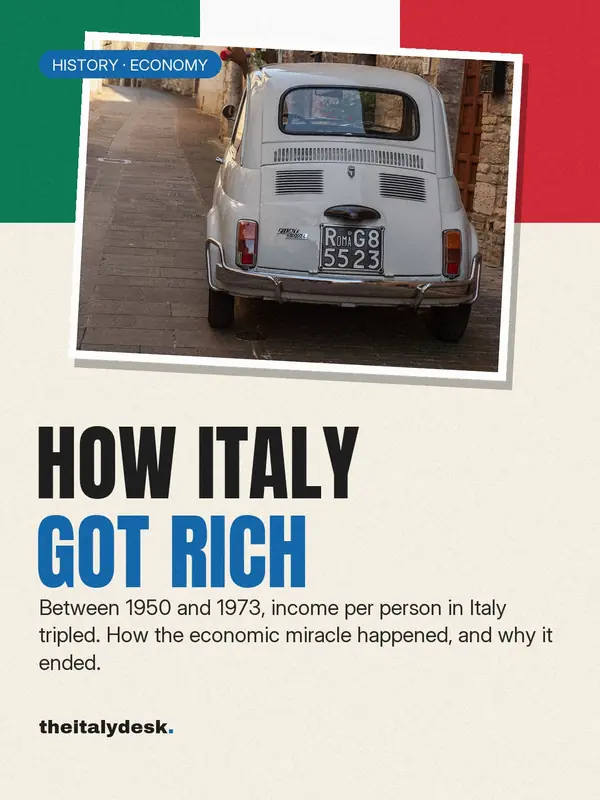
In 1950 the average Italian produced about half as much as the average Briton. By 1973 income per person in Italy had tripled and the gap had almost closed. Italians call those years il miracolo economico, the economic miracle. This piece explains where the country started, what drove the boom, who paid for it, why it ended, and what is left of it today.
Where Italy started
In 1945 Italy had lost a war, and bridges, railway lines and factories across the country had been destroyed. In Pontedera, in Tuscany, the Piaggio plant that had built aircraft engines was a military target and had been bombed flat.
The figures below come from the Maddison Project Database, which economic historians use to compare income per person across countries and over long periods. They are in 2011 dollars, adjusted for differences in prices between countries.
| Year | Italy | United Kingdom | Italy as a share of the UK |
|---|---|---|---|
| 1950 | $5,582 | $11,061 | 50% |
| 1958 | $8,544 | $12,698 | 67% |
| 1963 | $11,576 | $14,583 | 79% |
| 1973 | $16,950 | $19,168 | 88% |
Between 1958 and 1963, the peak of the boom, income per person in Italy grew by about 6.3% a year on the same data. West Germany grew by 4.5%, France by 4.1% and Britain by 2.8%. Of the large economies only Japan grew faster.
Money and a stable lira
Two things came first. Between 1948 and 1952 the American Marshall Plan, officially the European Recovery Program, sent Italy about $1.5 billion, mostly raw materials and food. Only Britain and France received more, according to the US Mutual Security Agency, which ran the programme.
The aid was also political. Italy had the largest Communist party in Western Europe. The Communists and their Socialist allies opposed the plan, and Alcide De Gasperi's Christian Democrats supported it. In the general election of 18 April 1948 the Christian Democrats won 48.5% of the vote, according to the Interior Ministry's historical archive.
Economists still disagree on how much the money itself mattered. In a 2011 study for the Bank of Italy, the economic historians Nicholas Crafts and Marco Magnani write that the aid was worth about 2% of Italy's gross domestic product (GDP), less than the average for countries in the plan, and that its direct effect on growth was probably small. They argue that it mattered more for modernising steel, metal and electrical plants and for pushing Italy towards open trade.
At home, Luigi Einaudi, then budget minister and later President of the Republic, stopped runaway inflation in 1947 with a squeeze on bank lending. In 1949 the lira was fixed at 625 to the US dollar, a level Crafts and Magnani describe as undervalued, which made Italian goods cheap abroad.
Cheap labour from the farms
The second ingredient was people. In the South and in the countryside, millions of farm workers had little land and no steady job. Crafts and Magnani write that cheap labour "poured from the Southern agricultural sector into the Northern plants".
In 1951 agriculture employed 44% of Italian workers. By 1973 it employed 18%. With so many people looking for work, wages rose only a little faster than productivity, the two historians note, so factories could grow without pricing themselves out of export markets.
The movement was huge. Between 1955 and 1971 about nine million Italians moved from one region to another, according to the historian Paul Ginsborg in A History of Contemporary Italy. Many went to the "industrial triangle" of Milan, Turin and Genoa. Turin had about 719,000 residents in 1951 and more than a million ten years later, according to the city's statistical yearbook.
Others went abroad, to Belgian coal mines and to factories in Switzerland and Germany. In December 1955 West Germany signed an agreement with Italy to recruit Italian workers.
What Italy made
The products of the miracle are still familiar:
- The Vespa. Enrico Piaggio needed something new to build in his bombed plant. The engineer Corradino D'Ascanio designed a scooter you could ride in work clothes, Piaggio filed the patent on 23 April 1946, and the millionth Vespa left the factory ten years later.
- The Fiat 500. Fiat launched the 600 in 1955 and the Nuova 500 on 4 July 1957: under three metres long, with a 13-horsepower engine. Across its versions, Fiat built almost 3.9 million 500s by 1975.
- Fridges and washing machines. Small workshops such as Candy near Milan, Ignis near Varese and Zanussi in Pordenone became mass producers. In 1973, according to the record of a parliamentary committee, Italy's industry minister said the world had three big centres of appliance making: Japan, the United States and Italy.
- Olivetti. In Ivrea, north of Turin, Adriano Olivetti's company made the Lettera 22 portable typewriter (1950), now in the collection of the Museum of Modern Art in New York, and in 1959 presented the Elea 9003, Italy's first commercial computer.
- Fashion. In February 1951 the Florentine businessman Giovanni Battista Giorgini showed Italian clothes to American buyers in his home. Florence still dates the birth of Italian fashion as an industry to that evening.
Open markets and the state
In March 1957 Italy signed the Treaty of Rome with France, West Germany, Belgium, the Netherlands and Luxembourg, creating the European Economic Community. Tariffs between the six began to fall in 1959. Italy's share of the world's manufactured exports rose from 3.7% in 1950 to 6.8% in 1973, according to Crafts and Magnani.
The state also played a large part. ENI, the state energy company founded in 1953 and led by Enrico Mattei, sold cheap gas from the Po Valley to northern industry. State-owned steelworks went up in Genoa and later in Taranto. From 1950 a public development fund for the South, the Cassa per il Mezzogiorno, paid for roads and aqueducts and later for factories. In 1949 a public housing plan, INA-Casa, began building homes for workers, many on the edges of the growing cities.
On 4 October 1964 Prime Minister Aldo Moro opened the last section of the Autostrada del Sole, the motorway from Milan to Naples: more than 750 kilometres, built in eight years. The first stone had been laid outside Milan on 19 May 1956. Italy had fewer than 50 cars for every 1,000 people in 1961, and more than 200 ten years later.
Why it ended
By the early 1960s northern factories were running short of workers. Wages rose fast and prices followed, and in 1963 the Bank of Italy tightened credit. Growth slowed.
In 1969 came the autunno caldo, the "hot autumn": months of strikes in the big factories, where many of the strikers were migrants from the South. Unions won higher pay, and in 1970 Parliament passed the Workers' Statute, a law that still defines many labour rights in Italy.
Then, in 1973, came the oil shock. Fuel prices soared and the government banned private cars on Sundays and holidays. On Sunday 2 December 1973 Italians walked and cycled down empty roads. The golden age of growth was over, in Italy and across the West.
What the miracle did for the South
Between 1951 and 1973 the gap in income per person between the North and the South narrowed "for the first and only time in history", Crafts and Magnani write, and they link it to the years when the Cassa per il Mezzogiorno worked best. The gap narrowed. It did not close, and it has not narrowed in the same way since.
Crafts and Magnani also note what the boom did not build. In the 1960s Italy spent about 0.6% of its GDP on research and development, around a third of the West German level, and high-technology industries stayed weaker than in the other big European economies.
What is left
Italy is still the second-largest manufacturer in the European Union after Germany, measured by manufacturing value added (Eurostat, 2025). Vespas are still made in Pontedera, and on 4 July 2007, fifty years to the day after the original, Fiat launched a new 500.
Growth never returned to that speed. On OECD figures, the average Italian wage, adjusted for inflation, is lower today than in 1990. That is one reason the miracle still comes up in Italian debates: within one generation, the country came close to the richest economies in Europe.
Our full video on the economic miracle, with archive films and an interview with a man who worked with Adriano Olivetti, is on The Italy Desk's YouTube channel.
Maddison Project Database 2023 (Bolt and van Zanden), GDP per person; N. Crafts and M. Magnani, "The Golden Age and the Second Globalization in Italy", Bank of Italy, Quaderni di storia economica n. 17, 2011; Mutual Security Agency, monthly report, June 1952; Interior Ministry, historical election archive (18 April 1948); ISTAT, L'Italia in 150 anni; City of Turin, statistical yearbook; Camera dei deputati, Bollettino delle Commissioni, 16 February 1973; Paul Ginsborg, A History of Contemporary Italy; Piaggio (Vespa patent, 23 April 1946); Stellantis Heritage and Wikipedia (Fiat 500 production); Museum of Modern Art; Il Post, 4 October 2024 (Autostrada del Sole); Eurostat, nama_10_a64, 2025; OECD, average annual wages.
More in Economy & Money · Culture
Watch the reel on InstagramFound this useful? The Italy Desk is free to read. A small tip helps us keep it that way.
Support us on Ko-fi