Why Italians earn less than in 1990
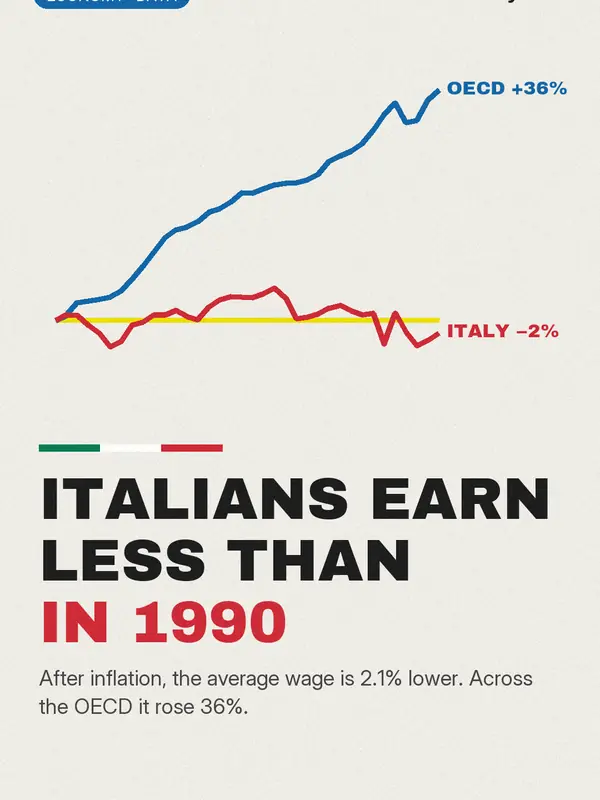
After inflation, the average Italian worker earns less today than in 1990. According to the OECD, the average yearly wage in Italy is 2.1% below its 1990 level, while across the rich world it rose by 36%. Of the 24 OECD countries with data going back to 1990, only two are still below where they started: Japan and Italy. Below are the main reasons, based on official data from the OECD, Eurostat, Istat and Italy's Parliamentary Budget Office, and what the government and its critics propose.
Italy and the rest
The OECD measures the average yearly wage of a full-time equivalent worker, adjusted for prices. Over 35 years the gap between Italy and the other large European economies has become wide.
| Country | Change in the average real wage, 1990 to 2025 |
|---|---|
| Germany | +35% |
| France | +35% |
| Spain | +16% |
| OECD average | +36% |
| Italy | -2.1% |
In today's money, the average Italian salary was worth about €35,500 in 1990. It peaked in 2010 at just over €37,000, then slid back to about €34,700 in 2025.
Adjusted for living costs, the average Italian earned more in 1990 than the average worker in Spain, Britain or France. Spain first moved ahead in 1994, and for good in 2019. Britain overtook Italy in 2001 and France in 2011. Today a worker in France earns about 12% more than one in Italy.
An economy that stopped growing
Wages are only part of the story. Adjusted for inflation, Italy produced less than 4% more per person in 2025 than in 2007, the year before the financial crisis, according to Eurostat. Across the European Union, output per person grew by about 18%.
Italy took three blows in a row: the global financial crisis in 2008, the euro debt crisis in 2011 and 2012, and then the pandemic, when its economy shrank by almost 9% in a single year.
In May 2025 Fabio Panetta, governor of the Bank of Italy, linked low wages to that weakness. Since the start of the century, he said, real wages had grown much less than in the other main European countries, by just 6% up to the pandemic, and the inflation shock that followed brought them back below their 2000 level.
How pay used to work
For most of the post-war period, Italian wages were linked to prices by a mechanism called the scala mobile, the "escalator". When prices went up, pay went up automatically. In 1992, during a currency and budget crisis, the government, unions and employers agreed to scrap it. From 1993, pay rises were set in national contracts, sector by sector, every few years.
The new system helped bring inflation down. Growth in pay was supposed to come from productivity instead.
Cause one: productivity
Wages can only keep growing if every hour of work produces more. Since 1995, output per hour has grown by about 42% across the EU and by 35% in Germany, according to Eurostat. In Italy it has grown by 8%.
One reason often given is the size of Italian firms. Four in ten people who work in Italian businesses are in firms with fewer than 10 employees. In the EU the share is three in ten, and in Germany it is fewer than one in five. Small firms, on average, invest less and produce less per hour.
What little extra value there was did not fully reach pay packets either. Italy's Parliamentary Budget Office (UPB) found that between 1990 and 2018 output per hour grew by 18%, while pay per full-time worker grew by less than 3%.
Cause two: part-time jobs
The second problem is the kind of jobs Italy created. In 1990, about four private-sector employees in a hundred worked part-time. By 2018 it was almost one in three, according to the UPB, which used data from INPS, the national social security institute. Eurostat data show that at least half of Italy's part-time workers would rather work full-time.
That pulls the average down. In the private sector, workers with a full-time job all year round have seen their pay rise by 14% since 1990. Everyone else has lost ground, and the losses are largest at the bottom of the scale.
| Private-sector employees | Change in real pay since 1990 |
|---|---|
| Full-time, all year round | +14% |
| Industry and construction | +16.5% |
| Services | -21% |
| One-tenth of the way up the pay scale | -41% |
| Middle of the pay scale | -13% |
| Nine-tenths of the way up | +3% |
Services are where most Italians work.
Cause three: the 2022 price shock
When energy prices soared in 2022, Italian pay could not keep up. Prices rose by almost 9% in 2022 and by another 6% in 2023. Between 2021 and 2023 the average real wage fell by 5%, the biggest drop in the G7, according to the OECD.
The way contracts work explains part of the delay. A national contract usually covers three years, and renewals are often late. At the end of 2021, more than half of all employees were waiting for a new contract, according to Istat. In the public sector, every employee worked on an expired contract for more than seven years.
From late 2023, pay started to catch up. Now prices are rising again. In October, inflation on the EU-harmonised measure reached 5.6%, the highest since September 2023, driven by energy. In a hearing on 12 October, Istat told Parliament that the recovery in pay had stopped. Our separate piece on October's inflation and zero growth, "Italian prices rose 5.4% in a year", has the details.
Women and men
On paper, Italy looks like one of the fairest countries in Europe for women's pay. Per hour, women earn about 5% less than men, against 11% across the EU (Eurostat).
Per year, the picture changes. In 2024 the average woman in a private-sector job earned about €19,800 and the average man almost €28,000, according to INPS. That is 29% less.
The reason is who works, and for how long. Only 58% of Italian women aged 20 to 64 have a job, the lowest rate in the European Union. The European Commission notes that where few women work, the hourly gap can look small, because those who do are often the best educated. Many of those in work are part-time: in 2024, 44% of women employed in the private sector worked part-time, against 16% of men.
North and South
In 2022, in companies with at least 10 employees, the average worker in the north-west earned about €40,000 a year before tax. In the South it was about €32,000 (Eurostat, Structure of Earnings Survey).
Behind that is a gap in output. Per person, the Centre-North produces 1.75 times as much as the South, according to Istat. Fewer people work, too: 76% of adults have a job in the north-east, against 54% in the South.
More of the economy is also off the books. Istat counts more than 3 million irregular full-time equivalent jobs in Italy, 13% of the total. In 2023 the unobserved economy, including illegal activity, was worth about 16.5% of value added in the South and 9% in the north-west.
Life is cheaper in the South, mostly because of housing. A Bank of Italy study put prices there about 16% lower, though its data go back to 2006.
What the government is doing
The government's main answer has been to cut taxes on work. Italy takes one of the biggest shares of a pay packet in the OECD: almost 46% of what a worker costs goes in tax and contributions, against 35% on average (OECD, Taxing Wages 2026). In the 2026 budget, the income tax rate on earnings between €28,000 and €50,000 fell from 35% to 33%.
The UPB says 30 years of income tax reforms have softened the blow for low and middle earners. It also warns that there is little room left to do more through taxes, and that the structural causes are still there.
On pay itself, the government chose a "fair wage" over a legal minimum. The governing majority rewrote an opposition bill on the minimum wage into Law 144/2025, which ties the fair wage to the total pay set by the main national collective agreements. Decree-law 62/2026, approved by the cabinet on 28 April 2026 and later converted by Law 112/2026, builds on it. Prime Minister Giorgia Meloni said the incentives in the decree would only be available to employers who recognise and pay the fair wage. She argued that an hourly minimum wage could end up replacing, rather than adding to, the total pay that contracts provide today, and could lower workers' rights. After the final vote in Parliament, labour minister Marina Calderone said the government was writing the fair wage into law and anchoring it to total pay.
What the critics say
Italy is one of five EU countries without a national minimum wage, according to Eurostat. The opposition proposed a legal floor of €9 an hour. Elly Schlein, leader of the Democratic Party (PD), the largest opposition party, said the government's fair wage is close to a minimum wage with one big difference: it does not set a floor that pay cannot go below. Maurizio Landini, leader of the CGIL, Italy's largest union, criticised the April decree, saying all the money in it went to businesses and none to workers.
What comes next
On 28 October the cabinet approved the budget for 2027. It is now in Parliament, which must pass it by 31 December, and pay will again be at the centre of the debate.
Tax cuts change what ends up in a payslip. They do not change gross pay, the figure at the top of it, which has barely moved in 35 years.
The full 10-minute explainer, with interviews and charts, is on The Italy Desk's YouTube channel, and a shorter version is on our Instagram.
OECD, Average annual wages (constant 2025 prices, US$ PPP and euros); OECD, Taxing Wages 2026; Eurostat, real GDP per capita (nama_10_pc), real GDP (nama_10_gdp), labour productivity per hour (nama_10_lp_ulc), enterprise size (sbs_sc_ovw), HICP (prc_hicp_aind), gender pay gap (sdg_05_20), employment rates (lfsi_emp_a, lfst_r_lfe2emprt), Structure of Earnings Survey 2022 (earn_ses22_rann), minimum wages (January 2026); Parliamentary Budget Office (UPB), Working note 1/2026 (July 2026); Istat, collective agreements October to December 2021, hearing on the 2026 public finance plan (12 October 2026), consumer prices flash estimate (October 2026), unobserved economy 2021 to 2024, regional accounts 2022 to 2024; INPS, Observatory on private-sector employees (18 November 2025); European Commission, The gender pay gap situation in the EU; Bank of Italy, Occasional paper no. 49 (2009) and Governor's Concluding Remarks (30 May 2025); Budget Law 2026; Law 144/2025; Decree-law 62/2026, converted by Law 112/2026.
More in Economy & Money · Society
Watch the reel on InstagramFound this useful? The Italy Desk is free to read. A small tip helps us keep it that way.
Support us on Ko-fi