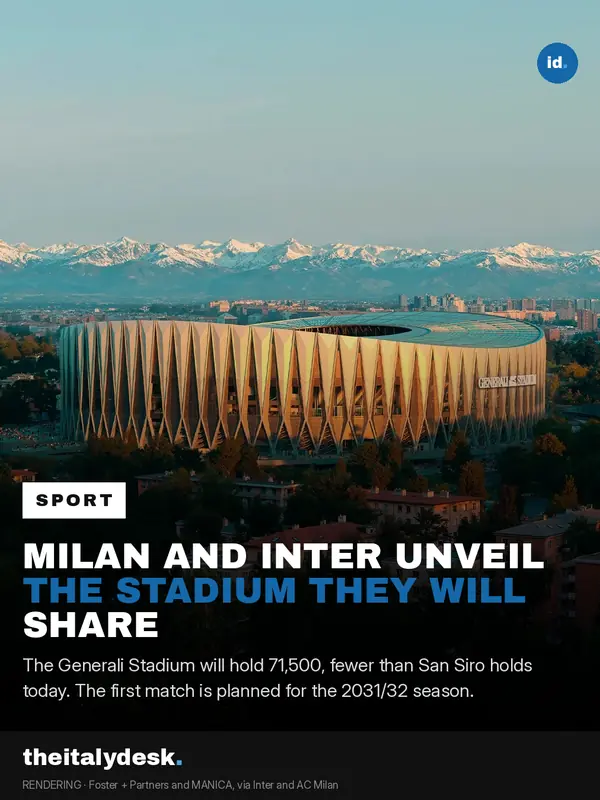
Milan and Inter unveil the stadium they will share
AC Milan and Inter, the two big football clubs of Milan, have shown the world the stadium they plan to share from the 2031/32 season. It will be called the Generali Stadium, after the insurance group that bought the naming rights, and it will hold about 71,500 people, fewer than San Siro, the 100-year-old ground it replaces. The design is public, but the building is not yet approved: a planning review, an environmental assessment and a criminal investigation into the sale of the land are all still open. Here is what was announced, how the clubs came to own San Siro, and what has to happen before work can start.
What was presented
The clubs unveiled the project on 29 October 2026 at the Castello Sforzesco, the Renaissance castle in central Milan. The architects are Foster + Partners, the London practice of Norman Foster, and MANICA, the US practice of David Manica.
| Generali Stadium (planned) | San Siro (today) | |
|---|---|---|
| Capacity for football | about 71,500 | 75,817 |
| Tiers of stands | 2 | 3 |
| Premium seats | more than 13,000 | not found |
| Opened | first match planned for 2031/32 | 1926 |
According to the architects' description, as reported by Urbanfile and NSS Sports:
- The pitch will sit about 15 metres below street level, and the building will rise to about 60 metres at its highest point.
- The stands behind the goals will be steeper than today, with a slope of up to 37 degrees, to bring fans closer to the pitch.
- The outside is a frame of large concrete diagonals forming an X pattern. The architects say it recalls the buttresses of Milan's cathedral, the Duomo.
- The roof will carry about 27,000 square metres of solar panels, which Urbanfile describes as the largest on any stadium in the world.
- The stadium is designed to keep crowd noise inside, so that less of it reaches the surrounding streets.
- For concerts, capacity could exceed 100,000.
The €650 million name
Generali, Italy's largest insurance group, will pay €650 million over 25 years for the name, about €26 million a year, Il Sole 24 Ore reports. The paper puts the deal among the most valuable stadium naming agreements in the world, above Spotify's deal with Barcelona's Camp Nou (about €20 million a year) and Allianz's with Juventus (about €15 million). Generali also becomes the official insurance partner of both clubs.
In a joint statement, Generali's chairman Andrea Sironi and chief executive Philippe Donnet said the stadium would "strengthen the city's role" as one of Italy's major venues known around the world.
How much it will cost
The clubs have not published one official figure, and the reports we read give different ones. MalpensaNews, reporting from the presentation, puts the whole investment at about €2.3 billion, of which more than €700 million for the stadium itself. When the land was sold in 2025, Il Post reported a planned investment of about €1.2 billion for the stadium and the redevelopment of the area. The difference may come from what each figure includes; we could not confirm it from a club document.
How the clubs came to own San Siro
San Siro was built for Milan and opened in 1926. Inter moved in as a tenant in 1947 and never left. Since 1980 the stadium has officially been named after Giuseppe Meazza, a footballer who played for both clubs, and many Italians call it "the Meazza".
For decades the ground belonged to the City of Milan. On 30 September 2025, the city council voted to sell it, with the land around it, to the two clubs. The deed was signed on 5 November 2025. The buyer is Stadio San Siro S.p.A., a company the two clubs own together, and the price was €197 million, Il Post reported.
The timing mattered. On 10 November 2025 a heritage protection would have come into force on the stadium's second tier, which was about to turn 70 years old. Under Italian law that protection, applied by the Soprintendenza, the state office for cultural heritage, would have made demolition much harder. The sale closed five days before.
The two clubs will keep playing at the old San Siro while the new stadium is built next to it.
What happens to the old stadium
Most of the old San Siro will be demolished once the new stadium is in use. In 2025 Il Post reported that about 91% of the structure would come down. According to Calcio e Finanza and MalpensaNews, a section in the south-east corner, part of the blue and orange sectors and the corner between them, will be kept and reused. Demolition is expected to start in 2031, or once the new stadium is ready, and to take about a year. A second phase, with new buildings around the preserved section, is due to end around 2035.
Approvals still needed
The stadium is one part of a larger plan covering about 281,000 square metres, which includes about 98,000 square metres of offices, hotels and shops, according to Calcio e Finanza. The steps reported so far:
- 16 March 2026: the clubs' company submitted the implementation plan (piano attuativo) for the whole area.
- Mid-September 2026: an environmental report was filed for the Strategic Environmental Assessment (VAS). Public bodies and citizens can now send observations, and the city has to give its opinion.
- Next: the technical and economic feasibility project for the stadium goes to a "conferenza di servizi", a joint review by all the public offices involved, run by the Lombardy region under Italy's stadium law, together with an Environmental Impact Assessment (VIA).
- The City of Milan and the Lombardy region have agreed a 560-day timetable for the permits, with the aim of finishing by summer 2027.
Reports differ on when building will start. Calcio e Finanza and MalpensaNews say the second half of 2027. Urbanfile and NSS Sports, reporting the presentation, say 2028, which is also the date in our Instagram post. Construction is expected to take about four years.
The court cases
Two legal processes are running alongside the planning review.
In the administrative courts, committees and residents opposed to the demolition filed five appeals against the sale. The regional administrative court of Lombardy (TAR) rejected all five, Il Fatto Quotidiano reported on 6 October 2026: four were ruled inadmissible and one was rejected on its merits. The court did not rule on the stadium's heritage value. We did not find reports of an appeal to the Council of State, Italy's highest administrative court.
In the criminal courts, Milan prosecutors are investigating nine people over the sale, Il Post reported on 31 March 2026. They include city officials, a former city councillor for urban planning, consultants for both clubs and a former Inter executive. The suspected offences are bid rigging and disclosure of official secrets: prosecutors suspect that draft decisions were shared with the clubs in advance and that the procedure was shaped to suit them. Nobody has been charged, and everyone under investigation is presumed innocent. When the investigation first emerged in November 2025, Milan's mayor Giuseppe Sala said the city had done "everything according to the rules", Calcio e Finanza reported. As of October 2026 the investigation was still open, according to Il Fatto Quotidiano.
Euro 2032
Italy will host the 2032 European Championship together with Turkey, and the opening date of the new stadium is tied to it. On 30 September 2026 the Italian Football Federation (FIGC) sent UEFA, European football's governing body, files on 14 candidate stadiums in 13 cities. Milan entered the new stadium, because the current San Siro does not meet more than half of UEFA's requirements, according to Calcio e Finanza. The federation will choose five Italian venues after UEFA's review. We did not find a date for that decision.
Inter and AC Milan, presentation of 29 October 2026; Urbanfile, 29 October 2026; NSS Sports; MalpensaNews, 29 October 2026; Il Sole 24 Ore (English edition), October 2026; Calcio e Finanza, 8 October 2026 and 7 November 2025; Il Fatto Quotidiano, 6 October 2026; Il Post, 5 November 2025 and 31 March 2026; Sky Sport, 30 September 2025; Arab News, 30 September 2026.
More in Sport · Economy & Money
See the post on InstagramFound this useful? The Italy Desk is free to read. A small tip helps us keep it that way.
Support us on Ko-fi