Italy's top court switches off its biggest steelworks
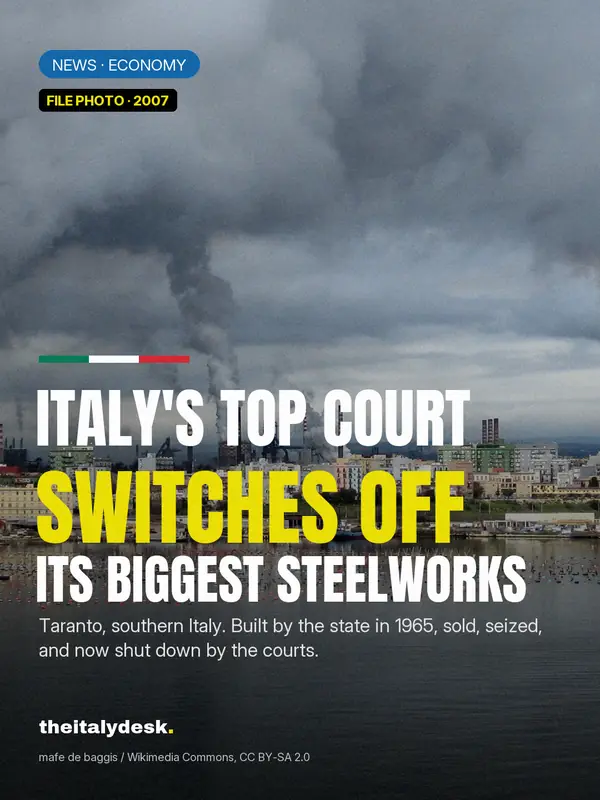
On the morning of 6 November the last furnaces in the hot area of the Taranto steelworks, in southern Italy, went cold. It is the country's largest steel plant, and Italy's top court has ruled that it cannot make steel again until it stops endangering the health of the people who live around it. The company wants to put up to 8,622 of its 9,626 workers on state-funded leave, and binding bids for the group are due by midnight on Sunday 8 November. Here is what the courts decided and why, how the plant got here, what happens to the workers and who might still buy it.
What has been switched off
Steel at Taranto is made in what Italians call the "area a caldo", the hot area. It holds the coke ovens, which bake coal into fuel, the blast furnaces, which turn iron ore into liquid iron, and the steel shop, where that iron becomes steel. The rest of the site, the cold area, rolls and finishes steel into sheets and coils.
The plant had already stopped producing steel on 8 October, according to ItaliaOggi. Only one of its four blast furnaces was still in use, and it was being kept warm with gas. On 3 November a contractor began dismantling the burners, AGI reported. On 6 November Maurizio Saitta, director general of Acciaierie d'Italia, the company that runs the plant, told unions that "since this morning nothing is switched on", according to union sources quoted by Il Diario del Lavoro and ItaliaOggi.
The group also runs plants in Genoa, Novi Ligure and Racconigi, in the north, which process steel made in Taranto. They now need slabs and coils from other producers. One hot rolling mill in Taranto will work slabs bought elsewhere until January, the Fiom union said.
What the courts decided
The case was not brought by the state. In July 2021 eleven Taranto residents went to the business court in Milan with a collective "inhibitory action", a lawsuit that asks a judge to stop conduct harming many people at once. The Puglia region and two associations joined them.
| Date | Court | Decision |
|---|---|---|
| 25 June 2024 | EU Court of Justice (case C-626/22) | Answering questions from the Milan court: when a plant poses serious dangers to health or the environment, it must be suspended, and deadlines to comply cannot keep being extended |
| 26 February 2026 | Court of Milan | The plant is currently dangerous; the hot area is suspended from 24 August unless its permit sets firm deadlines |
| 27 July 2026 | Milan Court of Appeal | The hot area must stop within 90 days, over asbestos and fine dust |
| 9 and 30 September 2026 | Milan Court of Appeal | Order confirmed |
| 29 October 2026 | Court of Cassation, joint civil chambers | Appeals by Ilva and Acciaierie d'Italia rejected; the order is final |
The Cassation ruling, 60 pages long, rests mainly on asbestos. The plant's 2017 environmental permit required asbestos to be removed from the cowpers, the towers that heat air for the blast furnaces, by 23 August 2023. According to AGI, 2,140 tonnes are still there. A new permit issued in 2025 allowed up to 6 million tonnes of steel a year until 2037 and no longer set a date for removal. The court treated this as one more extension of the kind the EU court had ruled out, according to a summary of the ruling published by the legal site Diritto.it. It cited a rate of mesothelioma, a cancer caused by asbestos, about four times the expected level. Because asbestos was enough to decide the case, the court did not rule on fine dust.
The judges went against the conclusions of the court's own prosecutor general, who had objected to the Milan judges' reasoning, AGI reported. The plant can restart only once the asbestos is fully removed and fine-dust emissions are within safe limits.
Health concerns did not start with this case. In January 2019 the European Court of Human Rights ruled in Cordella and Others v. Italy that Italy had breached Taranto residents' right to private life by failing to protect them from the plant's pollution. Studies by the Istituto Superiore di Sanità, Italy's national health institute, known as the SENTIERI reports, have found higher mortality and illness in the Taranto area than in the rest of Puglia.
Sixty years in brief
- 1960 to 1965: the state builds the plant; in 1981 more than 20,000 people work there.
- 1995: the state sells it to the Riva family. Output peaks at nearly 10 million tonnes in 2007.
- 2012: judges in Taranto seize the hot area over its emissions. A year later the state takes control through a commissioner.
- 2018: ArcelorMittal, the world steel group, buys the plant.
- 2021: the state comes back in as a partner through Invitalia, its investment agency.
- February 2024: the state pushes ArcelorMittal out and puts Acciaierie d'Italia into extraordinary administration, run by government-appointed commissioners.
- May 2025: blast furnace 1 is stopped and seized by Taranto prosecutors after a fire.
- 2026: the Milan courts and then the Cassation order the hot area to stop.
A separate criminal trial over pollution from the plant between 1995 and 2012, known as "Ambiente svenduto" ("environment sold off"), was moved from Taranto to Potenza in 2024 and is still under way.
What happens to the workers
Italy's main tool for workers at a company in crisis is the cassa integrazione, a state-funded scheme that pays part of the wages of staff placed on leave. Acciaierie d'Italia has asked to extend it to as many as 8,622 employees until 28 February 2027, almost double the 4,450 now on it. About 1,000 would stay at work on safety and plant security.
| Site | Workers | On leave under the request |
|---|---|---|
| Taranto | 7,875 | 6,964 |
| Genoa | 917 | 870 |
| Novi Ligure | 542 | 515 |
Figures from ItaliaOggi; Taranto staff numbers are from July.
Talks at the Ministry of Labour on 6 November ended after four hours without an agreement and resume on Tuesday 10 November. The company, short of cash, says it can no longer advance the payments and wants INPS, the national social security institute, to pay workers directly. Fiom said there were no conditions to sign. Uilm called for a special law with early retirement and exit incentives. Unions have called assemblies of all workers on 10, 11 and 12 November.
The contractor firms that work for the plant employ thousands more. A government decree covers 4,200 of their workers with wage support from October 2026 to June 2027, and contractors began collective dismissals of more than 2,500 people in September, ItaliaOggi reported.
What each side says
The government, in a statement from Palazzo Chigi, the prime minister's office, said it "can only take note" of the ruling and "will not shy away from its responsibilities". It pointed to a recent decree-law and to a meeting with unions on 27 October, which produced a document the unions signed.
Elly Schlein, leader of the Democratic Party, the largest opposition party, said that health is not negotiable. The main metalworkers' unions, Fim, Fiom and Uilm, want a faster switch to electric furnaces and guarantees for workers. The smaller Usb union wants the sale cancelled and the state to take the lead.
The 2027 to 2029 budget bill removes €720.6 million from a fund meant to pay for decarbonising steel. Antonio Misiani of the Democratic Party called it a serious and unacceptable choice, and Mario Turco of the Five Star Movement said the government was contradicting itself. Fim-Cisl said the cut goes against what was agreed on 27 October. We did not find a government explanation of the cut in the reports we read.
Who might buy it
Binding offers for the group are due by midnight on 8 November. Any buyer would have to plan for electric furnaces and plants for direct reduced iron, a cleaner way of making iron, which would take at least two to three years to build.
- A consortium of Italian steelmakers led by Federacciai, the industry federation: its chairman, Antonio Gozzi, said on 3 November that "the decision has not yet been taken". Italian press reports say it is mainly interested in the rolling mills, not the hot area.
- Jindal Steel International, from India: it had looked at the whole group, furnaces included. No official word since the ruling.
- Flacks Group: says it is still in the race and, according to Reuters, is asking the government for a loan of at least €1 billion.
What happens next
The bids are opened after Sunday, and the commissioners will assess the industrial plans that come with them. Talks on wage support resume on 10 November. Who pays to remove the asbestos, and whether the northern plants can find enough steel elsewhere, are still open questions. This is a developing story: this article reflects what was known on the evening of 6 November.
Court of Cassation, joint civil chambers, ruling of 29 October 2026, as reported by AGI (29 October) and summarised by Diritto.it; Milan Court of Appeal, decree of 27 July 2026; EU Court of Justice, C-626/22 (25 June 2024); European Court of Human Rights, Cordella and Others v. Italy (24 January 2019); ISS, SENTIERI reports; AGI (29 October and 3 November 2026); ItaliaOggi (6 November 2026); Il Diario del Lavoro (6 November 2026); Il Post (29 October 2026); QuiFinanza (29 October 2026); Reuters via ItaliaOggi.
More in Economy & Money · Society
Watch the reel on InstagramFound this useful? The Italy Desk is free to read. A small tip helps us keep it that way.
Support us on Ko-fi