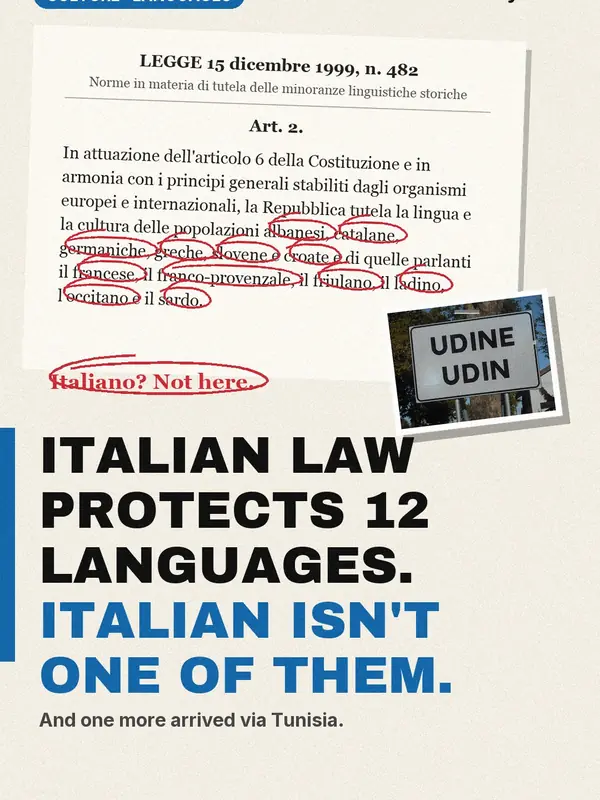
Italian law protects 12 languages, but not Italian
Italian law protects 12 languages, and Italian is not one of them. The reason is simple: Italian does not need protecting. Law 482 of 15 December 1999 opens by saying that "the official language of the Republic is Italian", then lists the 12 historical minority languages the state promises to protect. Here is what the law covers, where those languages are spoken, how many people speak them, and what it leaves out, including a language that reached Sardinia by way of a coral island off Tunisia.
What the law says
The Italian Constitution of 1948 does not name an official language. Its article 6 says only that "the Republic protects linguistic minorities with special rules". For half a century, those rules existed in just a few regions. The 1948 autonomy statutes of the Aosta Valley and Trentino-Alto Adige, which have constitutional rank, put French and German on an equal footing with Italian in their territories.
Law 482 was the first national law on the subject. Article 1 makes Italian the official language. Article 2 lists the minorities the Republic protects: the Albanian, Catalan, Germanic, Greek, Slovene and Croatian populations, and those who speak French, Franco-Provençal, Friulian, Ladin, Occitan and Sardinian.
Protection is local. Each area is drawn by the provincial council, after consulting the towns concerned, at the request of at least 15% of the registered voters who live there or a third of the town councillors. Inside it, the language can be taught in schools, used in town councils and public offices, and written on road signs next to the Italian name. That is why Udine, in Friuli, is also Udin, and Montemitro, in Molise, is also Mundimitar.
Where the 12 are spoken
| Language | Main areas |
|---|---|
| Albanian (Arbëresh) | Villages across the South, from Molise and Calabria to Sicily, such as Piana degli Albanesi near Palermo |
| Catalan | Alghero, Sardinia |
| Germanic | South Tyrol, plus small Alpine communities such as the Walser and the Cimbrians |
| Greek | Salento in Apulia (Griko) and the area around Reggio Calabria |
| Slovene | Provinces of Trieste, Gorizia and Udine |
| Croatian | Three villages in Molise |
| French | Aosta Valley |
| Franco-Provençal | Aosta Valley, Alpine valleys of Piedmont, two villages in Apulia |
| Friulian | Friuli Venezia Giulia |
| Ladin | Dolomite valleys of South Tyrol, Trentino and the province of Belluno |
| Occitan | Alpine valleys of Piedmont, and Guardia Piemontese in Calabria |
| Sardinian | Sardinia |
Several of them arrived with migrations. The Croatian of Molise was brought by families fleeing the Ottoman advance in the 15th and 16th centuries, according to the Croatian government's office for Croats abroad. The Catalan of Alghero dates from 1354, when the town was repopulated with settlers from Catalonia. Piana degli Albanesi, founded by Albanian refugees, has a second official name in its statute: Hora e Arbëreshëvet. In Salento, some towns speak Griko, a Greek dialect, and the name of one of them, Calimera, means "good morning" in Griko, according to italia.it, the national tourism site.
How many people speak them
Italy has no national census of languages. The figures come from regional surveys, taken in different years with different methods, so they cannot be added up or compared.
- Friulian: about 444,000 active speakers, and about 700,000 people who understand it, according to a 2023 survey by the IRES FVG research institute with ARLeF, the regional agency for the Friulian language.
- Sardinia: 68.4% of people said they know and speak a local language in a survey for the Region of Sardinia published in 2007. The survey covered Sardinian and the island's other varieties.
The language that arrived via Tunisia
In the 1540s, the Lomellini, a family of Genoese merchants, took over the island of Tabarka, off the coast of what is now Tunisia, for its coral. They brought fishermen from Pegli, near Genoa, and the community stayed for almost two centuries. In 1738, as the coral began to run out, King Charles Emmanuel III of Sardinia let many of them settle the island of San Pietro, off the south-west coast of Sardinia. They founded Carloforte, named after the king. Their language, Tabarchino, a variety of Ligurian, is also spoken in Calasetta, on the nearby island of Sant'Antioco.
It is still very much alive. In the same 2007 survey, 85% of people asked in Carloforte said they actively speak it, and nobody said they could not understand it. The report itself calls the local sample small and the figure indicative.
Tabarchino is not in Law 482. Sardinia recognised it in a regional law of 1997. The 2018 regional law that replaced it promotes Tabarchino together with Sassarese and Gallurese, two varieties spoken in the north of the island.
Who else is left out
Law 482 protects minorities tied to a territory, and that choice leaves out two large groups.
ROMA AND SINTI. An estimated 120,000 to 180,000 Roma and Sinti live in Italy, according to Eurac Research, an institute in Bolzano. Because they are spread across the country rather than settled in one area, they are not covered by the law. A bill to recognise them as a cultural community, tabled in the Senate during the 2013 to 2018 parliament, was not adopted.
REGIONAL LANGUAGES. Neapolitan, Sicilian, Venetian and the many other local languages that Italians usually call dialects are not on the list. In 2016, Veneto passed a regional law that treated Venetians as a "national minority". The Constitutional Court struck it down in 2018 (ruling 81/2018). It said that deciding which groups count as minorities is a job for national law, with the same criteria across the country, and that a region cannot declare its own population a minority.
Italy and Europe
Italy ratified the Council of Europe's Framework Convention for the Protection of National Minorities in 1997. It signed the European Charter for Regional or Minority Languages in 2000, but had still not ratified it in 2024, according to the European Centre for Minority Issues.
What we don't know
How many languages are spoken in Italy in total depends on who counts and how. Figures of 30 or more circulate online, often attributed to UNESCO's atlas of endangered languages, but we could not check them at the source, so we do not use them. The 12 in this piece are the ones the law names.
Law 482 of 15 December 1999, arts. 1 to 10; Constitution of the Italian Republic, art. 6; autonomy statutes of the Aosta Valley and Trentino-Alto Adige; Sardinian regional laws 26/1997 and 22/2018; Region of Sardinia, "Le lingue dei sardi", final report, 2007; ARLeF and IRES FVG, survey on Friulian, 2023; Central State Office for Croats Abroad (Croatian government); italia.it; Statute of Piana degli Albanesi; Italian Foreign Ministry; Musei di Genova; Eurac Research; Constitutional Court, ruling 81/2018; European Centre for Minority Issues, 2024.
Found this useful? The Italy Desk is free to read. A small tip helps us keep it that way.
Support us on Ko-fi