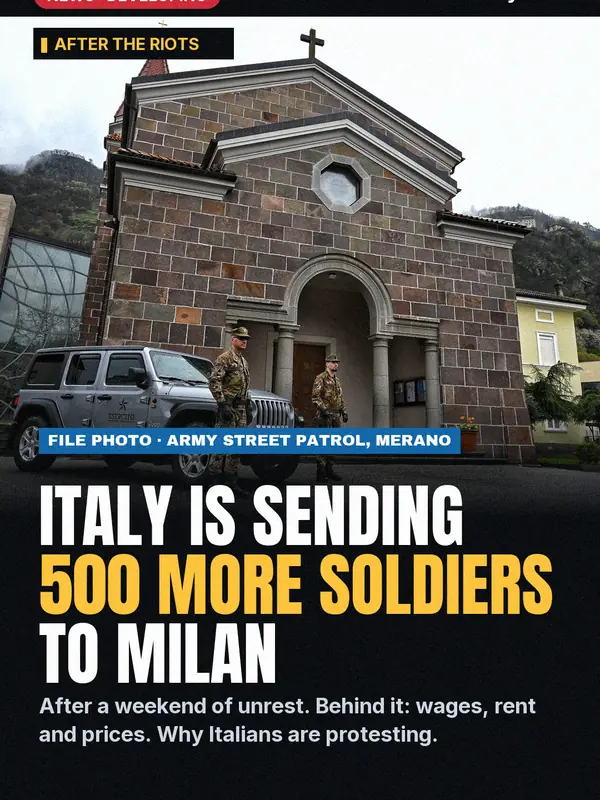
Italy is sending 500 more soldiers to Milan
On Tuesday 20 October the Italian cabinet approved an emergency decree in response to a weekend of unrest, mostly in Milan. It sends 500 more soldiers to the city, creates a new offence of violent participation in a demonstration, and changes how the law treats teenagers who take part. Parents can now be fined for what their children do.
The people who marched in the days before had other complaints: prices, rent, wages. Here is what the government decided, what happened over the weekend, and what the numbers say about those complaints.
What happened in Milan
On Saturday 17 October a march against the cost of living in Milan ended in clashes with police, and protests in Bologna, Brescia, Bergamo and Turin also turned violent. On Sunday several hundred young people, many with their hoods up, set bins on fire and looted shops in the city centre, Reuters reported.
Police took 271 people to Milan's police headquarters after Sunday's unrest, 220 of them minors, according to Sky TG24. Reuters reported that 32 were arrested, 23 of them minors. Fourteen police officers were injured, and Confcommercio, the retailers' association, puts the damage at around €1 million. Figures on arrests differ between sources and are still changing as courts review each case. Everyone arrested is presumed innocent until a court decides otherwise.
What the decree does
Decree-laws in Italy take effect as soon as they are published, and Parliament then has 60 days to turn them into law. This one, titled "urgent provisions on public security and combating juvenile crime", has eight articles. The main measures, as described by ministers and reported by Il Post, Open and Money.it:
- 500 more soldiers in Milan until 31 December 2026, at an estimated cost of about €4.7 million. They join Strade Sicure, the army's street patrol operation, which already has around 6,000 soldiers in Italian cities. The soldiers guard sensitive sites and support the police. They cannot arrest, investigate or write up offences.
- A new offence of violent participation in a public demonstration. It applies to anyone in a group of at least five people who uses or throws dangerous objects or fireworks and puts others in real danger. The penalty is two to five years in prison and a fine of €10,000 to €20,000, more if faces are covered or people are hurt. Organising or promoting such a group, including online, carries four to twelve years. Taking part peacefully in a march is not covered.
- Teenagers are treated as liable. Until now, judges checked case by case whether a 14 to 17 year old understood what they were doing. Under the decree, that capacity is presumed unless proven otherwise.
- Preventive detention of people considered dangerous, already possible for adults, now applies to minors and to crowded public places. Police can also arrest someone up to 48 hours after the fact if photos or videos clearly identify them.
- Prefects can fine the parents of a minor involved in violence €500 to €1,000, doubled for a repeat, unless the parents show they could not have prevented it. For damage to public property, the prefect can order compensation directly.
- Police chiefs can ban people with a record of violent or intimidating behaviour from gathering in groups of five or more, for up to a year. This includes teenagers from 14 who already face police measures.
One measure was dropped. The government had said the soldiers would get police powers, including arrest. That was removed after objections from the office of President Sergio Mattarella, according to Il Post and Al Jazeera. Defence Minister Guido Crosetto said "an opportunity was lost to use the military in a different way" (Il Foglio).
Three protests in one week
The Milan march was not an isolated event. In the same week, young people called online by a new network, Italia in Piazza, marched in 13 cities. In Rome a union march organised by CGIL, Italy's largest trade union, drew over 100,000 people, by the organisers' count. In the south, truckers and farmers have been blocking roads over diesel prices since early October.
Italia in Piazza lists four demands: action on prices and fuel, rent, wages, and public services such as schools and health care.
What the numbers say
Wages first. Adjusted for inflation, the average annual wage of an Italian employee was 2.3% higher in 2025 than in 1995, according to the OECD.
| Real average wage, change 1995-2025 | % |
|---|---|
| Poland | +124.4 |
| United Kingdom | +39.3 |
| France | +27.5 |
| Germany | +23.7 |
| Belgium | +19.9 |
| Spain | +7.8 |
| Italy | +2.3 |
On rent, a 40 square metre flat in Milan is listed at about €890 a month, based on Immobiliare.it's average asking rent of €22.32 per square metre in September 2026. In Rome the same flat costs about €765. Across Italy, a single earner can afford only 13% of the homes listed for rent, according to Immobiliare.it Insights.
Every year since 2021, far more Italian citizens have moved abroad than have come back, ISTAT, the national statistics office, reports.
| Year | Moved abroad | Came back |
|---|---|---|
| 2021 | 94,219 | 74,759 |
| 2022 | 99,510 | 74,490 |
| 2023 | 114,057 | 61,286 |
| 2024 (provisional) | 141,056 | 58,468 |
| 2025 (provisional) | 109,004 | 56,451 |
Where you start matters. Among Italian adults aged 25 to 59 who grew up in a household that struggled financially, 34% are at risk of poverty. The EU average is 20% (Eurostat, 2023). Among Italians aged 25 to 34, 64.7% of those with at least one graduate parent have a degree. When neither parent finished high school, the figure is 12.8% (ISTAT, 2024).
Prices are rising again. Inflation for 2026 is already about 3%, while wages set by national contracts are growing about 2.5%. ISTAT told Parliament on 12 October that the two-year recovery of real wages stopped in the second quarter of this year.
What the government says
The government points to jobs. In May, Prime Minister Giorgia Meloni said employment in Italy "has reached record levels", with 1.2 million more permanent workers. Youth unemployment, for 15 to 24 year olds, was 20.3% in August, less than half its peak of 43.5% in July 2014, although it has risen from 17.7% in May (Eurostat, ISTAT). On fuel, Meloni said on 7 October that the government was ready to act.
On the decree, Meloni said: "We know the difficulties many young people face, but hardship can never become an excuse for violence" (Fanpage). On social media she wrote that "destroying and stealing is not protest, it is crime, and the state's response must be firm." Deputy Prime Minister Matteo Salvini, whose League party pushed for the troops, wrote: "From words to action: 500 more troops to defend Milan." Crosetto has blamed a "hybrid war" and "counter-education" of young people on social media (ANSA).
What the critics say
Opposition leaders condemned the violence and asked the government not to ignore the reasons for the protests. Elly Schlein, leader of the centre-left Democratic Party (PD), said the violence should not be used "to obscure the peaceful protests". Giuseppe Conte, leader of the Five Star Movement, said "the government must not ignore the hardship". Nicola Fratoianni of the Greens and Left Alliance (AVS) said the violence "obscures the reasons for the protest".
On the decree, PD deputy Arturo Scotto called it the government's eighth security decree "to increase offences". Anna Ascani, the PD deputy speaker of the Chamber, wrote that the prime minister always proposes a new offence, and asked: "Does it work? No." Before the police powers were dropped, AVS deputy Luana Zanella said the idea gave her "shivers of horror" (Sky TG24). SIAP, a police union, warned of an "authoritarian twist" in public order (ANSA). Milan's mayor, Giuseppe Sala, said it "cannot only be a problem of repression".
What happens next
- Wednesday 21 October, 6pm: CGIL holds a rally in Piazza della Scala, outside Milan's city hall, under the slogan "Milan does not want violence". The PD has joined. The Milan branch of CISL and UIL Lombardy, two other major unions, are not taking part.
- Saturdays: a group calling itself Movimento 17 ottobre has announced protests every Saturday, local media report. Sala said he was "quite worried" about the coming weekend.
- Tuesday 27 October: truckers meet the Transport Ministry over diesel prices.
- By mid-December: Parliament must vote the decree into law within 60 days of publication, or it lapses. It can amend it on the way.
What we don't know yet: when the extra soldiers will arrive, the final number of people charged, and whether the published text matches every detail announced on Tuesday. Reports of some penalties still differ.
Il Post, Sky TG24, ANSA, Open, Fanpage, 20 October 2026; Reuters, 19 October; Al Jazeera and Il Foglio, 21 October; Money.it; Il Giornale, 19 October (opposition statements); OECD average annual wages; Immobiliare.it; ISTAT (migration 2024-2025, Annual Report 2026, hearing of 12 October); Eurostat (EU-SILC 2023, youth unemployment); Adnkronos, 23 May 2026.
More in Society · Economy & Money · Politics
Watch the reel on InstagramFound this useful? The Italy Desk is free to read. A small tip helps us keep it that way.
Support us on Ko-fi