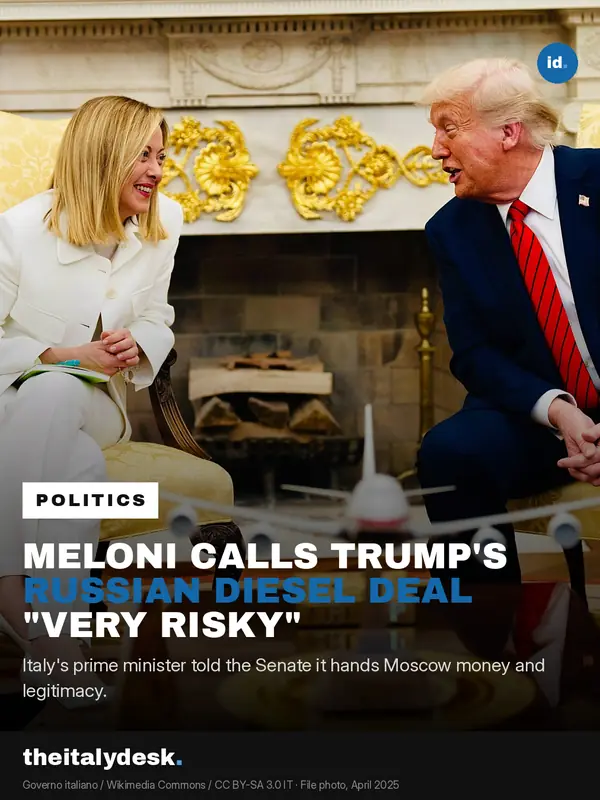
Meloni calls Trump's Russian diesel deal "very risky"
On Wednesday 14 October, in her usual address to the Italian Senate before a summit of EU leaders, Giorgia Meloni spoke about a deal made five days earlier by Donald Trump. "The agreement on Russian diesel announced last Friday by the President of the United States is a choice I consider very risky," Italy's prime minister said.
It is the clearest criticism she has made of a Trump decision on Russia. Here is what the deal is, who is objecting to it, and what Meloni actually said.
The deal
On Friday 9 October Trump announced on social media that he had agreed with Vladimir Putin, in a phone call, that Russia would supply diesel to the United States and to world markets. According to his announcement, more than 300,000 tonnes would come immediately, 500,000 tonnes in November, a further 1 million tonnes after that, and later another 3 million tonnes.
To make it possible, the US Treasury's sanctions office is issuing a temporary licence that lets Russian diesel reach the global market. The United States banned imports of Russian oil and gas in 2022, after the invasion of Ukraine.
The stated reason is price. US diesel reached a record $6.52 a gallon in September and was still around $6.20 when the deal was announced, according to the motoring association AAA. The war in Iran and the disruption in the Strait of Hormuz have squeezed global supply, and Americans vote in midterm elections on 3 November.
Analysts quoted by Al Jazeera doubted how much diesel Russia can actually deliver: Moscow banned its own diesel exports in July, after Ukrainian strikes hit its refineries.
Who objects in Washington
On Sunday 11 October six US senators asked the administration to "immediately reverse course": four Republicans, Susan Collins, Lisa Murkowski, Thom Tillis and John Curtis, and two Democrats, Jeanne Shaheen and Richard Blumenthal. They said Congress had not been consulted, and that the United States "should not provide Putin with a financial lifeline".
Tillis went further on NBC's Meet the Press: "I do believe there's a legitimate case for saying the president's not following the law." Not every Republican agreed. Senator John Barrasso said the president "is balancing" energy costs and has to make tough decisions.
Who objects abroad
Ukraine's president, Volodymyr Zelensky, called it "a weak decision by strong partners" that "plays into Russia's hands". The office of Canada's prime minister, Mark Carney, said the agreement would help finance Russia's war.
What Meloni said
Meloni's argument was about cause and effect. Fuel prices, she told senators, are rising "mainly because of the war in Iran, not the conflict in Ukraine". So, in her words, "the result of this choice is doubtful, while the risks are clear".
She listed three: "legitimacy for Moscow while its bombs continue to fall on Ukrainian cities, new revenue with which to finance the war, an implicit weakening of the sanctions lever". These, she said, "contradict what Western countries, the United States included, have done so far to push Putin to sit down at the negotiating table".
In the same speech she asked the 27 EU countries to choose one authoritative figure to speak for Europe in Ukraine peace talks. If France, Germany and Britain, the so-called E3, believe they can do better on their own, she said, they should at least do it "on behalf of everyone and with an official mandate".
Why it stands out
Meloni and Trump have clashed before this year: over his attacks on Pope Leo XIV in April, and over his claim in June that she had begged him for a photo. We traced that story, step by step, in our in-depth piece of 3 October. Those were mostly arguments about words and respect.
This one is about policy. Italy has backed Ukraine and the EU sanctions on Russia since 2022, and Meloni has kept that line since she took office that October.
What happens next
EU leaders meet in Brussels on Thursday 15 and Friday 16 October. Energy prices are expected to dominate. Whether Europe buys any of the Russian diesel is a separate question: the EU's own sanctions still bar it.
What we don't know yet: whether the US Treasury licence has been formally published, and how much diesel, if any, has left Russian ports.
Giorgia Meloni's address to the Italian Senate, 14 October 2026 (via ANSA); Al Jazeera, 10 and 11 October; PBS NewsHour/AP, 11 October.
More in Italy in the World · Politics
See the post on InstagramFound this useful? The Italy Desk is free to read. A small tip helps us keep it that way.
Support us on Ko-fi