In Sicily, the presents come from the dead
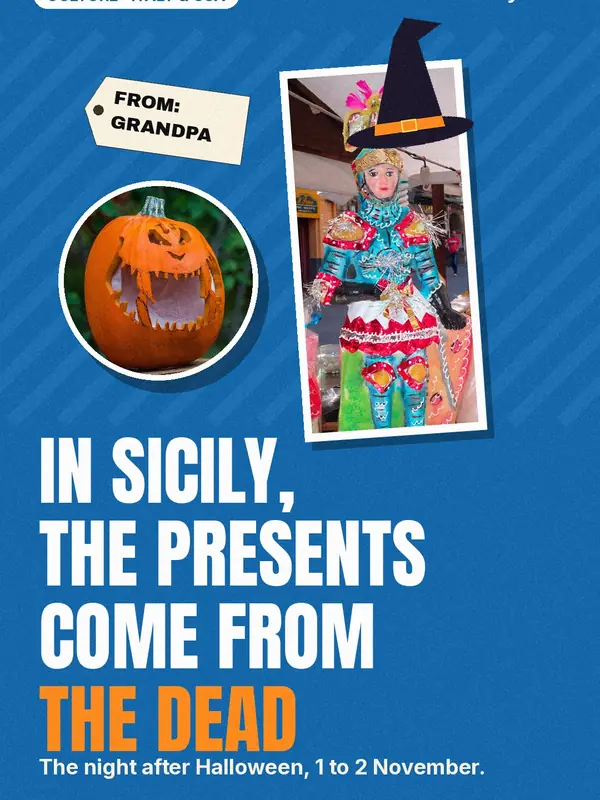
In Sicily, the presents traditionally come from the dead. On the night between 1 and 2 November, the night after Halloween, children are told that their dead grandparents and parents come home and leave them sweets and toys. It is the Festa dei Morti, the Feast of the Dead. This piece explains how the tradition works, what the sweets are, where their origin stories come from and how much of them can be checked, and why a famous Sicilian writer thought the custom was fading.
Two days in November
The Catholic calendar has two days for the dead. 1 November is Ognissanti, All Saints' Day, a national public holiday in Italy. 2 November is the Commemorazione dei defunti, All Souls' Day, when families across the country visit cemeteries. It is not a public holiday.
In Sicily, 2 November is also the day children get presents. Sicily's regional government, in a note published on 2 November 2020, described the gifts as left by "fathers, mothers and relatives who are no longer here" and found by children the next morning. The same note compared the feast to Mexico's Día de Muertos and called it a passing of memory between generations.
The dead in these stories are not frightening. They are family, and they come back to bring something.
The basket under the bed
The writer Andrea Camilleri, born in 1925 in Porto Empedocle, on the south coast of Sicily, and best known abroad for his Inspector Montalbano novels, described the ritual of his childhood in a short piece titled Il giorno che i morti persero la strada di casa ("The day the dead lost their way home"), collected in Racconti quotidiani (Libreria dell'Orso, 2001).
At bedtime, children left a basket under the bed. By morning it had gone, and they had to find it. Camilleri remembered discovering it "on top of a wardrobe or behind a door", full to the brim. Later in the day, at the cemetery, children asked each other: "What did the dead bring you this year?"
Camilleri wrote that every Sicilian home kept the custom when he was a boy. In a text from 2014 he noted that children no longer leave the basket out.
What is in it
Three sweets are tied to the day. All three are on the Regione Siciliana's official list of traditional food products (prodotti agroalimentari tradizionali, or PAT).
| Sweet | What it is | Note |
|---|---|---|
| Pupi di zucchero (pupi ri zuccaru, or pupaccena in Palermo) | Hollow figures of hardened sugar, painted by hand | Traditionally knights and ladies; today also cartoon characters |
| Frutta martorana | Almond paste (marzipan) shaped and painted to look like fruit | Named after the Martorana convent in Palermo |
| Ossa di morto ("bones of the dead"), also crozzi 'i mottu | Hard, crunchy biscuits, white on top | Eating them, the regional government wrote in 2020, lets the dead "go on living inside us" |
The figures are made in two-part moulds of plaster or terracotta. Santi Gnoffo, a researcher of Sicilian folk traditions writing for the Palermo news site Balarm in 2019, describes how the confectioner pours boiled sugar into the oiled moulds, ties the two halves together, lets the sugar set and then paints the front. Traditionally each confectioner owned his moulds, so the shapes were his alone. The most common figure was a paladin, one of the knights of Charlemagne's legends, often on horseback. Gnoffo also notes that the figures have become smaller in recent years, as the trade has struggled.
There are local variations. In Catania, which holds a yearly fiera dei morti, a fair of stalls and toys for the feast, rame di Napoli biscuits can come filled with pumpkin jam, according to Balarm. In Palermo, Balarm wrote in 2004, bakeries sold muffolette, soft rolls, early in the morning.
The origin stories, and what can be checked
The sweets come with legends. Most cannot be proved, and some contradict each other.
Frutta martorana. Visit Sicily, the regional tourism department's website, says the fruit was invented by the nuns of a Palermo convent founded by a noblewoman, Eloisa Martorana. In its version of the legend, the nuns were expecting an important visitor in early November, either the Archbishop of Palermo or the Emperor Charles V in 1535, and with no fruit left on their trees they hung marzipan fruit on the branches instead.
Balarm gives a different version, citing the writer Maria Oliveri: the convent was founded in 1194 by Goffredo and Eloisa Martorana, and the visitor was King Roger II, who reached for an orange and found it was almond paste. An official supposedly said the sweets were fit for a king, which would explain their other name, pasta reale ("royal paste"). That version has a problem with dates: Roger II died in 1154, forty years before the founding date the same article gives. What the sources agree on is the name. The church next to the convent, Santa Maria dell'Ammiraglio, is still called the Martorana.
Pupi di zucchero. Gnoffo records a legend about an Arab nobleman who had lost his fortune and asked his cook to make a dinner entirely of sugar. He also writes that sugar sculptures were served at a banquet in Venice in 1574 for Henry of Valois, the future King Henry III of France, and that Sicilian sailors brought the idea home. He does not name a source for that link, and we could not find one.
Fairs, then and now
Before 2 November, Sicilian towns hold fairs where families buy sweets and toys. Palermo's Fiera dei Morti runs from late October to 2 November. In 2024 it moved from via Basile to the grounds of the Fiera del Mediterraneo, the city's exhibition centre, Balarm reported. Pastry shops across the island still make the three sweets every year, and the sugar figures are still sold on market stalls.
Why it faded, according to Camilleri
Camilleri had his own explanation for why fewer Sicilian children wait for presents from the dead. In the same piece, he wrote that in 1943, when Allied troops landed in Sicily, the Christmas tree arrived with the American soldiers. Year after year, he wrote, the dead lost their way home.
That is his reading, offered as a writer's memory, not a study. We did not find data on how many Sicilian families still keep the custom.
Halloween falls on the night between 31 October and 1 November, so in Sicily the two nights now come one after the other: costumes and pumpkins first, then the night of the dead.
Regione Siciliana, note of 2 November 2020 and list of traditional food products (PAT); Visit Sicily (Regione Siciliana, tourism department), "Martorana fruit"; Andrea Camilleri, "Il giorno che i morti persero la strada di casa", in Racconti quotidiani, Libreria dell'Orso, 2001; Balarm: S. Gnoffo, 29 October 2019; M. Pezzino, 30 October 2021; 26 October 2004; 29 October 2021; 16 October 2024; LiveSicilia, 30 October 2012.
Found this useful? The Italy Desk is free to read. A small tip helps us keep it that way.
Support us on Ko-fi