Who really pays Italy's income tax
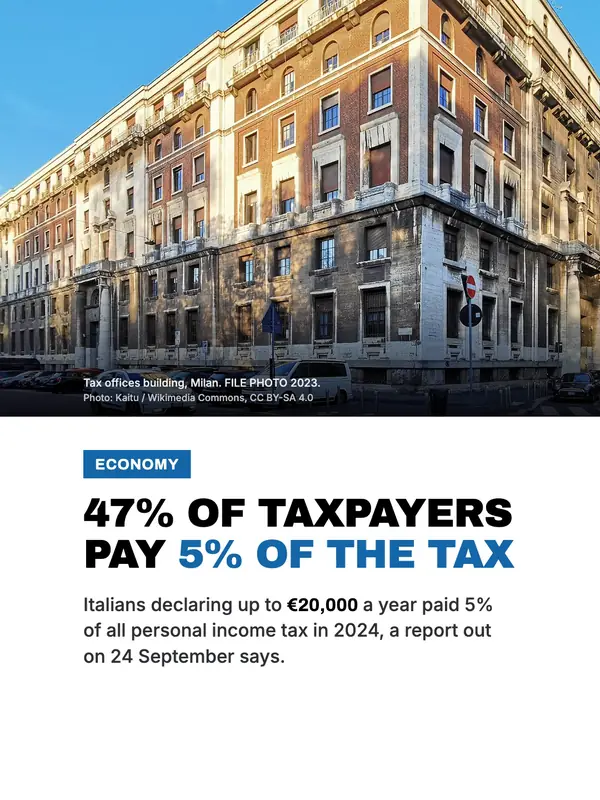
47% of Italy's taxpayers paid 5% of the country's personal income tax in 2024. They are the people who declared up to €20,000 a year, about 20.2 million of them, according to a report by the research centre Itinerari Previdenziali, presented on 24 September.
The tax is called Irpef. In 2024 it had three rates: 23% up to €28,000, 35% up to €50,000 and 43% above. Tax credits cancel it for employees earning under about €8,500 a year.
Italy has 58.9 million residents. 42.8 million filed a tax return, and 34.1 million paid any Irpef at all. The other 24.8 million paid none: 16.1 million filed no return, children included, and 8.7 million owed nothing.
At the other end of the scale, those declaring more than €35,000, about 8 million people or 18.8% of filers, paid 65% of the total. Above €100,000 there are 745,615 people, 1.75% of filers, who paid 22.25%.
The report was presented at CNEL, a state advisory body, during the 80th anniversary of CIDA, the federation of managers. Its president, Stefano Cuzzilla, said that "redistribution without reciprocity risks becoming the great Italian asymmetry". The report also points to incomes that have barely grown in years.
These shares count one tax and only declared income. Everyone also pays VAT on what they buy, and some self-employed people pay a separate 15% flat tax. Istat puts irregular work at 3.13 million full-time equivalent jobs in 2023, and the Economy Ministry estimates that about 60% of the Irpef due on self-employed and business income went unpaid in 2022. At the same time, 5.7 million people, 9.8% of residents, lived in absolute poverty in 2024, 1.28 million of them minors.
How does your country compare?
Itinerari Previdenziali, Istat, Economy Ministry, ANSA, Sky TG24, LaPresse, Open